

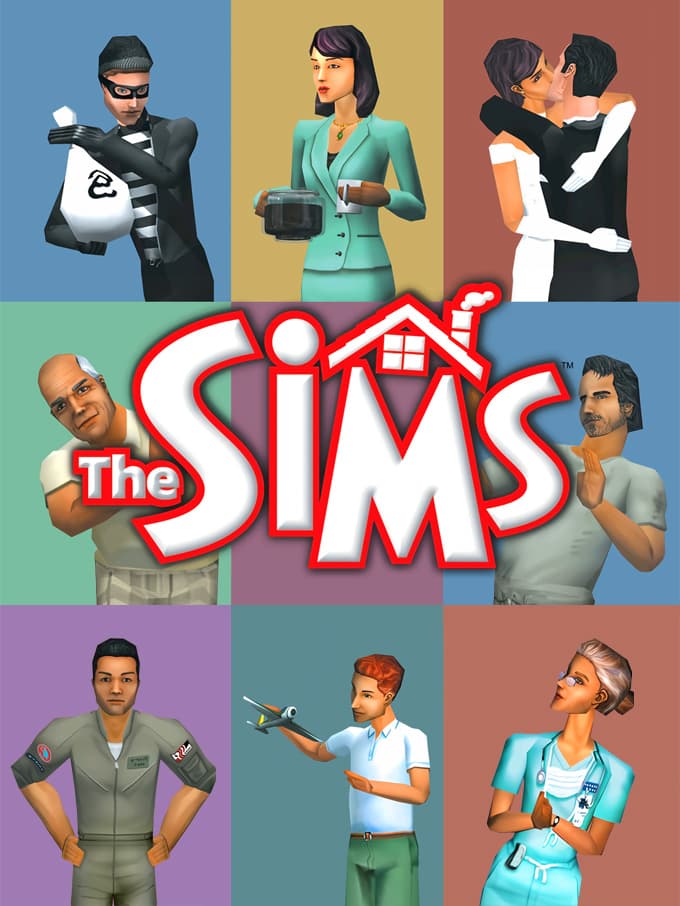
The Sims Review
2000MaxisGame
Will Wright turns a dollhouse into the best selling game on PC by simulating hunger, a bladder and the neighbors.
| Category | Critic | Users |
|---|---|---|
| Difficulty to make | Great | |
| Visuals | Good | |
| Story | Average | |
| Gameplay | Great | |
| Overall | Great |
The Sims sells on a premise every publisher told Will Wright would not work: no score, no enemy, no ending, just people with needs and a house that keeps costing money. It holds up because the simulation is legible. Every object carries its own behavior, so a refrigerator knows how to feed a Sim and a chess set knows how to raise logic, and an entire day falls out of those small contracts.
Reviewers in 2000 reached for the word toy and meant it as praise. You build a kitchen, watch it fail, rebuild it, and somewhere in there you start caring whether Bob gets out of the mailroom. Time has taken the visuals. The camera rotates in four hard steps, the resolution is of its moment, and the charm now lives in the animation and the babble rather than the pixels.
The story grade is the honest one, and it sits two steps under the overall on purpose. The Sims writes nothing down. There is no plot, no dialogue you can read, no character with a fixed history, and every famous story about this game is something a player did to a swimming pool. That is the design working exactly as intended, and it is still an axis a game that authors nothing cannot win. What it does author is a genre, an audience the industry had decided did not exist, and an expansion pack habit the series has never broken.
The Sims at a glance
- Platforms
- PC, Mac
- Developer
- Maxis
- Year
- 2000
What’s your grade?
Grade by category
No account needed. Sign in so your grades follow you and count once. · how vote integrity works
Comments
Plain text, 500 characters. Be sharp, not cruel.
No comments yet. Have the first take.