
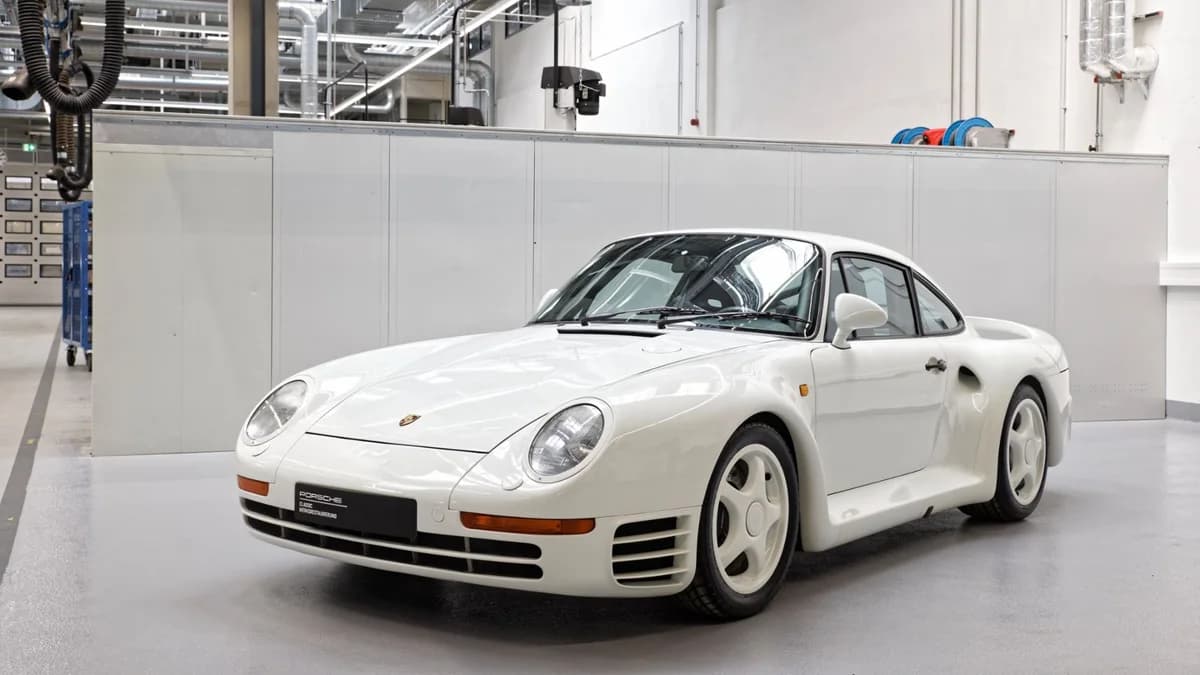
Porsche 959 Review
1987959Car
The most advanced road car of the 1980s still impresses, but its bespoke turbos, hydraulics and wheels make it a museum-grade commitment.
| Category | Critic | Users |
|---|---|---|
| Exterior | Great | |
| Interior luxury | Good | |
| Features | Good | |
| Reliability | Weak | |
| Economy | Weak | |
| Depreciation | Exceptional | |
| Maintenance cost | Avoid | |
| Innovation | Exceptional | |
| Engine | Great | |
| User experience | Good | |
| Overall | Great |
The 959 began in 1981, when chief engineer Helmuth Bott persuaded Porsche's new managing director, Peter Schutz, to fund a 911-based test bed for all-wheel drive and a Group B rally program. The Gruppe B prototype appeared at Frankfurt in 1983 and the road car at Frankfurt in 1985, but customer deliveries did not start until 1987, by which time Group B had been cancelled.
The rally cars still won the 1986 Paris-Dakar Rally, with René Metge first and Jacky Ickx second. The German price converted to about $225,000 at the time, and Porsche lost money on every car. It was never certified for sale in the US, and Bill Gates's car was held by US Customs for years before the 1999 Show or Display rule allowed it in.
The engine came from the 956 and 962 racing program: a 2,849 cc flat-six with air-cooled cylinders, water-cooled four-valve heads and two turbochargers working in sequence, one feeding low down and the second joining higher up, which smoothed out the on-off boost of Porsche's other turbo engines. It made 450 PS at 6,500 rpm and drove all four wheels through a six-speed gearbox whose first gear was marked G, for Gelände, while the PSK system could send up to 80 percent of the torque to the rear under hard acceleration.
Road & Track measured 3.6 seconds to 60 mph and 198 mph. What still impresses is how civil it was: adjustable ride height, a drag coefficient of 0.31 with zero lift, and a Komfort specification with air conditioning, electric windows and rear seats that made it usable in wet and snow as well as on a dry autobahn.
Owning one today is the opposite of civil. The turbochargers were never shared with another Porsche, and Stuttcars' buyer's guide names the hydraulic suspension as the costliest failure on the car; many owners have converted to conventional coilovers. The hollow magnesium wheels, which formed a sealed chamber for the first tyre pressure monitoring system on a production Porsche, need special run-flat tyres made in tiny batches, and specialists such as Canepa in California have engineered replacement wheels that take modern rubber. Values have moved the other way from the costs: RM Sotheby's sold a Komfort for $2,535,000 in January 2026, and Broad Arrow sold a Sport for $5,505,000 at Amelia Island that March.
The 959 matters more than almost any Porsche. It provided the basis for the first all-wheel-drive 911, the Carrera 4, and every 911 Turbo from the 993 onward has used all-wheel drive and twin turbochargers. It was widely considered the most technologically advanced road car of its time, and it remains quick by modern standards, but keeping one on the road takes a specialist and a budget with no obvious ceiling. It belongs near the top of the Porsche canon; the ownership experience keeps it a step short.
Porsche 959 at a glance
Official site- Make
- Porsche
- Model
- 959
- Model year
- 1987
- Body type
- Coupe
- Powertrain
- Sequential twin-turbo 2.85L flat-six, 6-speed manual, all-wheel drive
- Price
- 225000
What’s your grade?
Grade by category
No account needed. Sign in so your grades follow you and count once. · how vote integrity works
Comments
Plain text, 500 characters. Be sharp, not cruel.
No comments yet. Have the first take.