
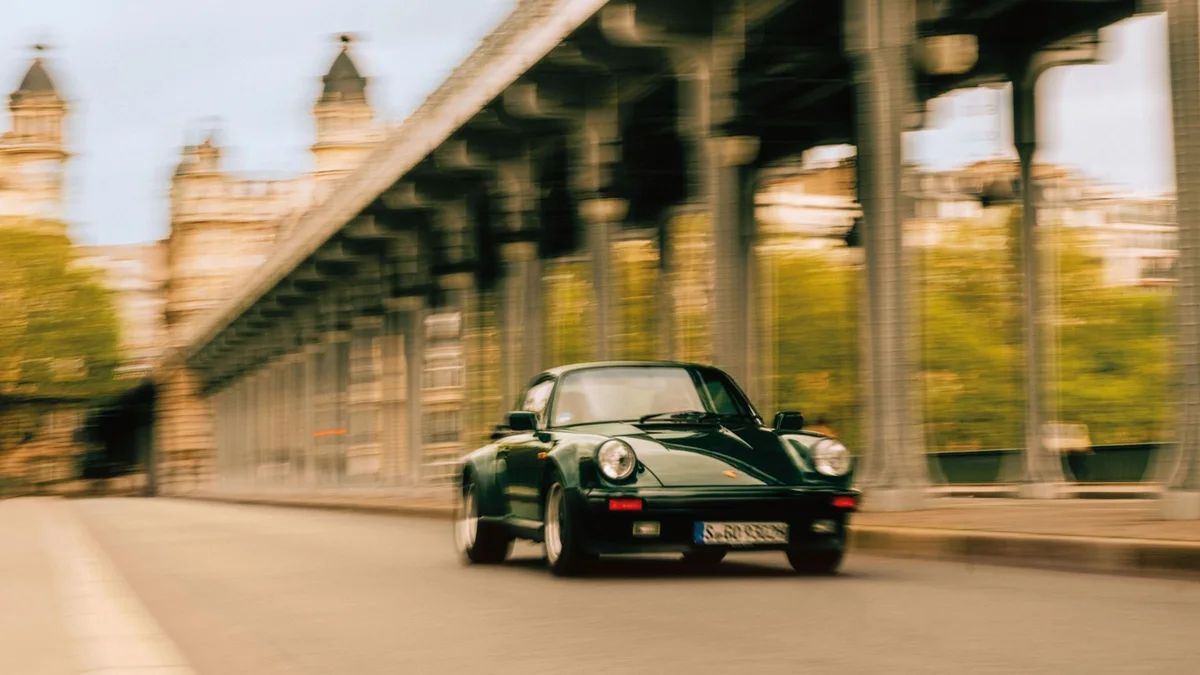
Porsche 911 Turbo (930) Review
1975911 TurboCar
Porsche's first turbocharged 911 is a landmark with sharp edges: lag, then a wall of boost, in a chassis that demands respect.
| Category | Critic | Users |
|---|---|---|
| Exterior | Exceptional | |
| Interior luxury | Good | |
| Features | Average | |
| Reliability | Average | |
| Economy | Weak | |
| Depreciation | Exceptional | |
| Maintenance cost | Weak | |
| Innovation | Great | |
| Engine | Great | |
| User experience | Average | |
| Overall | Great |
The 930 began as a homologation exercise. FIA rules for 1976 required 400 road cars for Group 4, and the Turbo became the basis of the 934 and 935 racers. Ernst Fuhrmann adapted the turbocharging Porsche had developed on the 917/30 Can-Am car, and the result, shown at the Paris show in October 1974 and on sale from spring 1975, was the fastest production car in Germany and the new top of the 911 range. American buyers got it for 1976, badged Turbo Carrera, with air conditioning, power windows, an AM/FM stereo and leather as standard.
The engine is the 3.0 liter flat-six from the Carrera RS 3.0 with a single KKK turbocharger, making 260 PS at 5,500 rpm and 329 Nm at 4,000 rpm on a 6.5:1 compression ratio. That low compression is the car's character: little happens until the boost arrives, then everything happens at once. Car and Driver timed the 1975 and 1978 Turbos at 4.9 seconds to 60 mph, a tie for the quickest car it tested in the 1970s. Porsche fitted revised suspension, bigger brakes, a stronger four-speed gearbox, a whale-tail spoiler and flared rear wings that made the car 12 cm wider, but the short wheelbase and rear engine remained, and too much throttle mid-corner could swing the tail out like a pendulum. The Widowmaker nickname came from crashes, not marketing.
Fifty years on, the 3.0 cars are specialist machines. The Porsche Club of America's model guide lists the checks for early Turbos: cylinder leak-down, broken head studs, cracks in the magnesium alternator and fan housing, and the health of the Bosch K-Jetronic injection. Buyer's guides add worn synchromesh in the four-speed and turbo bearings damaged by hot shutdowns, and fuel consumption is heavy. None of that has held values back. RM Sotheby's sold an 8,235-mile 1976 Turbo Carrera for $390,000 in 2023, an exceptional car, but ordinary ones also sell for several times their original price.
The 930 is less a great driver's car than a great moment: the car that took Porsche's racing turbo onto the road and started a line of 911 Turbos that Porsche still builds. It asks for skill, patience with the lag and a specialist on call, and it repays all three with a surge that still feels violent. As a first draft of the idea it is flawed; as a piece of Porsche history it has few equals.
Porsche 911 Turbo (930) at a glance
Official site- Make
- Porsche
- Model
- 911 Turbo
- Model year
- 1975
- Body type
- Coupe
- Powertrain
- Turbocharged 3.0L flat-six, 4-speed manual, rear-wheel drive
- Price
- 25850
What’s your grade?
Grade by category
No account needed. Sign in so your grades follow you and count once. · how vote integrity works
Comments
Plain text, 500 characters. Be sharp, not cruel.
No comments yet. Have the first take.