Porsche 911 Carrera RS 2.7 Review
1973911 Carrera RS 2.7Car
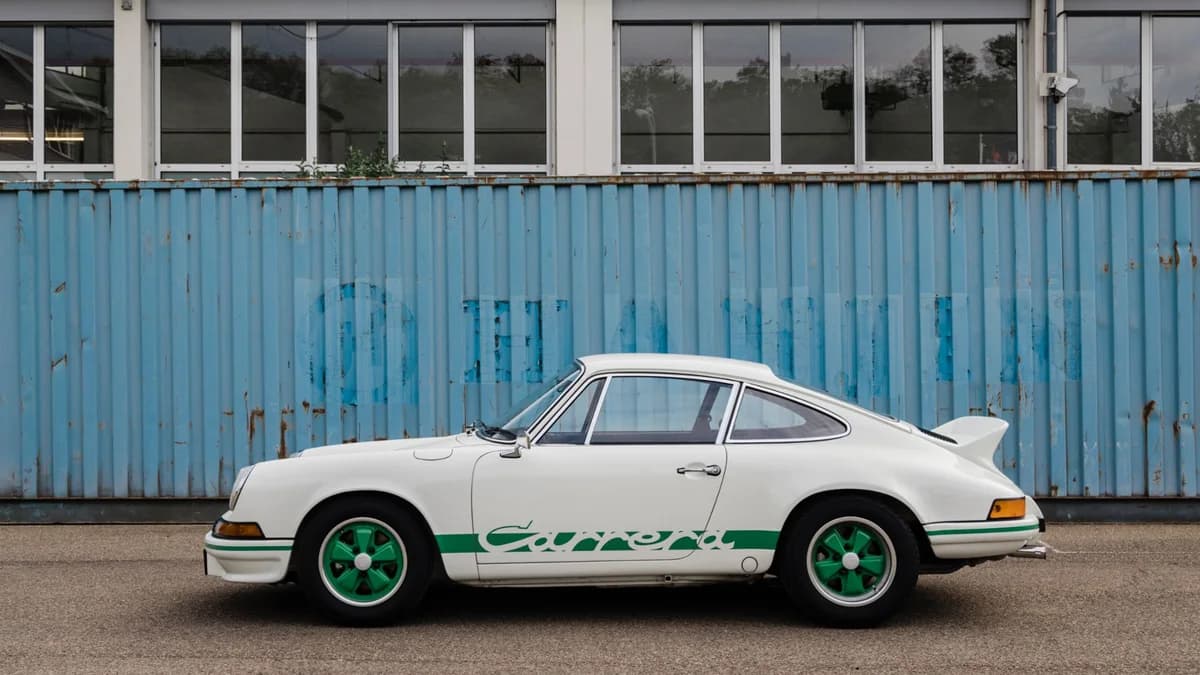
The homologation special that set the RS template: light, loud, ducktailed, and still the classic 911 by which the rest are judged.
| Category | Critic | Users |
|---|---|---|
| Exterior | Exceptional | |
| Interior luxury | Average | |
| Features | Weak | |
| Reliability | Good | |
| Economy | Average | |
| Depreciation | Exceptional | |
| Maintenance cost | Weak | |
| Innovation | Great | |
| Engine | Great | |
| User experience | Great | |
| Overall | Exceptional |
Porsche needed 500 road cars to take the 911 into FIA Group 4 GT racing, so it built the Carrera RS 2.7 and showed it at the Paris Motor Show on 5 October 1972. Demand outran the requirement, and the run grew to 1,580 cars: 200 stripped M471 Sport cars, known as Lightweights, 1,308 M472 Touring cars trimmed like a regular 911, plus 55 racing cars and 17 base cars. The list price was 34,000 marks, about $10,700 at the 1972 exchange rate. It was never sold new in the United States, where it could not meet federal emissions and safety rules.
The engine is a 2,687 cc flat-six with Bosch mechanical fuel injection, making 210 PS at 6,300 rpm and 255 Nm at 5,100 rpm. Mahle's Nikasil cylinder coating allowed thinner cylinder walls, which is what made the 90 mm bore possible. Porsche quotes 5.8 seconds from 0 to 100 km/h and 245 km/h for the 960 kg Sport. It was the first production car with front and rear spoilers and the first Porsche with different tyre sizes front and rear, and the ducktail was there to cut rear lift at speed.
The Lightweight used thin-gauge steel, thinner glass and plastic bumpers, and lost its trim strips, underbody protection and most of its insulation. With a five-speed 915 gearbox and unassisted steering, it is a light, direct, talkative car that rewards revs.
Living with one now is mostly a matter of specialists and paperwork. The mechanical injection pump and the magnesium-cased engine want someone who knows them, and originality drives the value, so a documented history matters as much as condition. The Touring is the easier car to use, with rear emergency seats, a clock and standard front seats, but its cabin is plain by any modern measure, and the Lightweight's is bare, with leather pull handles on simplified door panels.
Values have gone far past list. RM Sotheby's sold a Lightweight once owned by Otis Chandler for $1,875,000 in 2023, while a Touring made €353,750 at the auction house's Paris sale in 2026, so history and specification set the figure.
It is widely counted the greatest of the classic 911s, and the case is made on the spec sheet: less weight, more engine and aerodynamics that worked. The spare cabin and serious running costs are the terms of a homologation special rather than faults in it, and the car should be judged as what it set out to be. Every RS since has been measured against it.
Porsche 911 Carrera RS 2.7 at a glance
Official site- Make
- Porsche
- Model
- 911 Carrera RS 2.7
- Model year
- 1973
- Body type
- Coupe
- Powertrain
- Naturally aspirated 2.7L flat-six with mechanical fuel injection, 5-speed manual, rear-wheel drive
- Price
- 10700
What’s your grade?
Grade by category
No account needed. Sign in so your grades follow you and count once. · how vote integrity works
Comments
Plain text, 500 characters. Be sharp, not cruel.
No comments yet. Have the first take.