Porsche 911 (1964) Review
1964911Car
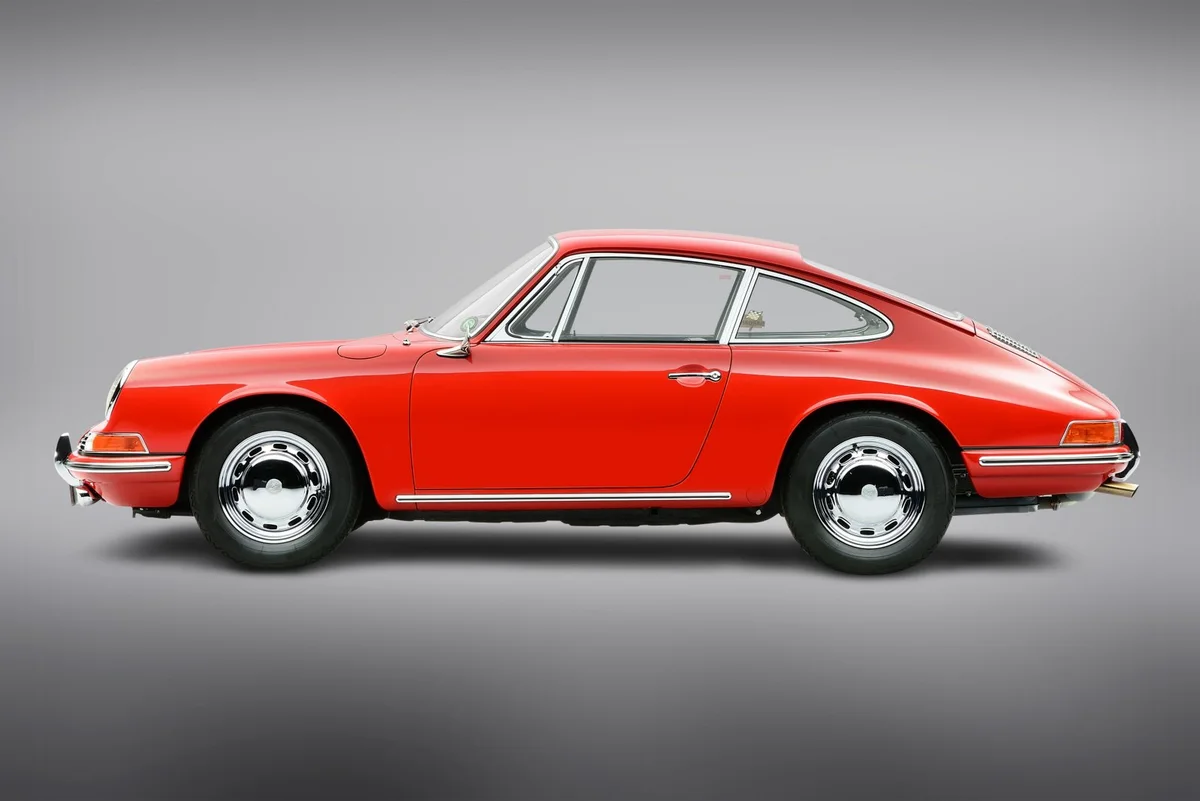
The first 911 was light at the nose and short of power next to its descendants, and the shape and the flat-six were right the first time.
| Category | Critic | Users |
|---|---|---|
| Exterior | Exceptional | |
| Interior luxury | Average | |
| Features | Average | |
| Reliability | Good | |
| Economy | Average | |
| Depreciation | Exceptional | |
| Maintenance cost | Average | |
| Innovation | Great | |
| Engine | Good | |
| User experience | Good | |
| Overall | Great |
Porsche showed the car as the 901 at the Frankfurt show on 12 September 1963 and began series production in September 1964. Peugeot objected that it owned three-digit names with a zero in the middle, so after 82 cars had been built as 901s the car became the 911 in every market. Ferdinand Alexander Porsche, known as Butzi, drew the body and Erwin Komenda's department engineered it: narrower and longer than the 356, on a longer wheelbase, with two small rear seats. It reached American showrooms early in 1965 at $6,500, Jaguar E-Type money and far more than a Corvette.
The engine shared almost nothing with the 356's four: a 1,991 cc air-cooled flat-six with one overhead camshaft per bank, dry-sump lubrication and two Solex carburettors, making 130 PS, with a five-speed gearbox, MacPherson struts at the front, semi-trailing arms at the back and rack-and-pinion steering. Car and Driver's first test, in April 1965, called it the Porsche to end all Porsches, or rather the start of a whole new generation.
It was also light at the nose. Short-wheelbase cars are more liable to snap oversteer, Porsche added a pair of 11 kg cast-iron weights to the front bumper as a fix, and the 1969 cars gained 57 mm of wheelbase to settle the handling. The Solex carburettors proved hard to keep in tune and gave way to Webers in 1966.
Sixty years on, early cars are specialist territory. Classic & Sports Car's buyer's guide warns that rust protection was limited, that valve guides wear quickly, that rust can build up in the dry-sump oil tank of a car left standing and wreck the engine once it circulates, and that gearbox synchros wear. The cam chains run on spring-loaded tensioners, which Porsche did not replace with hydraulic ones until 1984, and original Solex carburettors are now hard to find. Values have climbed with the legend: the Porsche Museum paid €107,000 in 2014 for the rusted remains of 901 No. 57, found in a shed, and Bonhams sold a restored 1965 car for €178,250 at its Zoute sale in October 2024.
Judged against what followed, the first 911 is a draft: less powerful than the 2.2 and 2.7 cars, nervous at the limit and fussy to keep in tune, and its engine and interior marks are modest. Judged as a starting point, it got the essentials right at the first attempt, the shape, the flat-six behind the rear axle and a usable 2+2 cabin, and Porsche has spent more than sixty years refining those three things. It is graded as the landmark it is; the best of the early 911s remains the Carrera RS 2.7.
Porsche 911 (1964) at a glance
Official site- Make
- Porsche
- Model
- 911
- Model year
- 1964
- Body type
- Coupe
- Powertrain
- Air-cooled 2.0L flat-six with two Solex carburettors, 5-speed manual, rear-wheel drive
- Price
- 6500
What’s your grade?
Grade by category
No account needed. Sign in so your grades follow you and count once. · how vote integrity works
Comments
Plain text, 500 characters. Be sharp, not cruel.
No comments yet. Have the first take.