Ferrari Testarossa Review
1984TestarossaCar
The poster car of the 1980s is a comfortable, fast grand tourer with a heavy gearshift, and a lesser driver's car than its image suggests.
| Category | Critic | Users |
|---|---|---|
| Exterior | Great | |
| Interior luxury | Good | |
| Features | Average | |
| Reliability | Average | |
| Economy | Avoid | |
| Depreciation | Good | |
| Maintenance cost | Weak | |
| Innovation | Average | |
| Engine | Great | |
| User experience | Average | |
| Overall | Good |
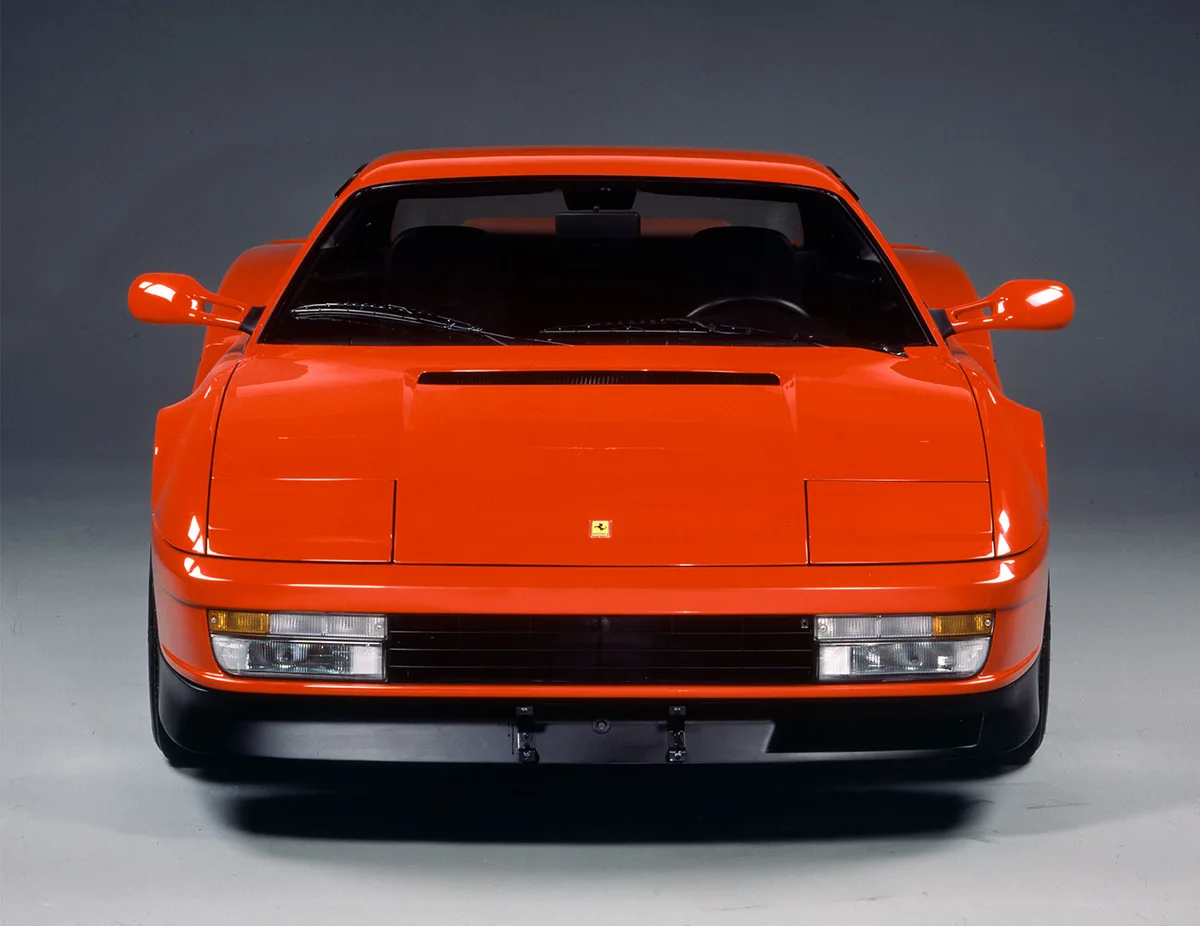
The Testarossa replaced the 512 BBi and set out to fix its two worst habits: a cabin cooked by coolant pipes running between a front radiator and the engine, and almost nowhere to put luggage. Pininfarina's team under Leonardo Fioravanti, developing a design originated by Emanuele Nicosia, moved the radiators to the flanks beside the engine and fed them through the side strakes that became the car's signature, a styling answer to rules in several countries against large open intakes. Ferrari designed it as a world car from the start, the first 12-cylinder model built for the American market in a decade, and Miami Vice and Sega's Out Run made it the face of the 1980s.
Its engine is a 4.9 liter flat-12 with four valves per cylinder and red cam covers, the red head of the name, borrowed from the 1957 250 Testa Rossa. It makes 385 hp at 6,300 rpm (early US cars made 380), and Ferrari quotes 5.8 seconds to 62 mph and 180 mph, serious figures in 1984. The car is nearly 78 inches wide and weighs 1,506 kg by Ferrari's count, with a carpeted luggage bay under the front lid and extra space behind the seats. Road & Track put it on its cover ten times in under five years, yet it lost comparison tests to the Lamborghini Countach, the Alpina B10 BiTurbo and the BMW M5, and its heavy gearshift was a standing complaint that Ferrari did not ease until the 512 TR.
Owning one means planning around the cam belts. The drivetrain and rear suspension were designed to drop out from underneath as a unit so the engine and timing belts could be serviced, and Classic & Sports Car's buyer's guide says the engine has to come out every three years for belt replacement. The same guide warns that infrequent use gums up the fuel metering heads and that the gearbox can baulk when cold, though it calls the box strong, and notes that these early cars are cheaper to work on than the 512 TR, whose engine comes out through the top.
The EPA rates it at 11 mpg combined. It cost about $85,000 new in 1985, and with almost 10,000 built across all three versions, values sit far below those of the limited-run Ferraris.
The Testarossa earns its place on design and on its engine. As a car to drive it was beaten in period by a Countach and by two BMW-based sedans, and it asks more of its owner's mechanic than of its owner. Ferrari thought enough of the name to revive it in 2025 for the SF90's successor, the 849 Testarossa, which says more about the badge's pull than about how this car drives.
Ferrari Testarossa at a glance
Official site- Make
- Ferrari
- Model
- Testarossa
- Model year
- 1984
- Body type
- Coupe
- Powertrain
- 4.9L flat-12, 5-speed manual, rear-wheel drive
- Price
- 85000
- Range or economy
- 11 mpg combined (EPA)
What’s your grade?
Grade by category
No account needed. Sign in so your grades follow you and count once. · how vote integrity works
Comments
Plain text, 500 characters. Be sharp, not cruel.
No comments yet. Have the first take.