
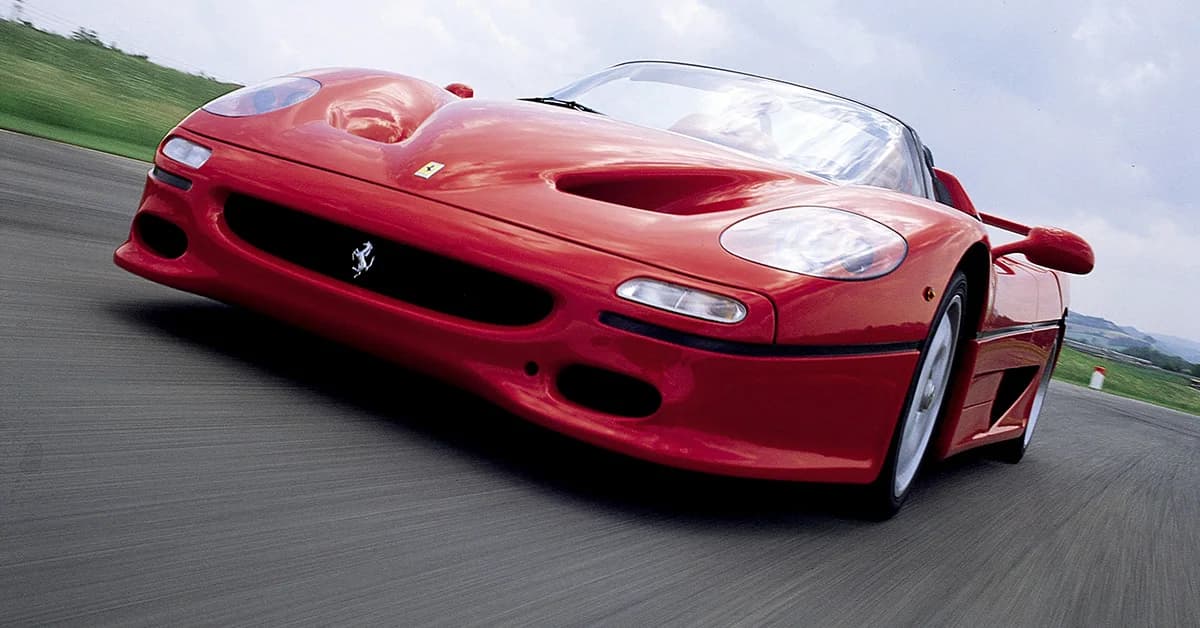
Ferrari F50 Review
1995F50Car
Panned in 1995 for not being an F40, the F50 put a Formula One-derived V12 behind the driver's head with nothing in between, and time has sided with it.
| Category | Critic | Users |
|---|---|---|
| Exterior | Good | |
| Interior luxury | Average | |
| Features | Weak | |
| Reliability | Average | |
| Economy | Avoid | |
| Depreciation | Exceptional | |
| Maintenance cost | Avoid | |
| Innovation | Great | |
| Engine | Exceptional | |
| User experience | Average | |
| Overall | Great |
Luca di Montezemolo presented the F50 at the 1995 Geneva show and said Ferrari would build 349, one fewer than it thought it could sell. The idea was to put a Formula One car's architecture on the road. The V12 was developed from the 3.5 liter engine of the 1990 641 grand prix car, the engine is bolted directly to a carbon fiber tub, and the rear suspension mounts to a spacer between engine and gearbox, as on a racing car. The shape evolved from the 1989 Mythos concept, with a nose that borrows from the Formula One cars of the day and a removable hardtop over a two-seat cockpit.
The engine is the reason to care. It is a 4.7 liter, 65 degree V12 with five valves per cylinder, titanium connecting rods and a cast iron block, making 513 hp at 8,500 rpm. There is no power steering and no ABS, the gearbox is a six-speed manual, and Bilstein dampers adjust themselves electronically. Ferrari quotes 1,230 kg, 3.87 seconds to 62 mph and 202 mph. Contemporary critics found it heavier and less elegant than the F40, a 1997 test managed only the mid-190s against that top speed claim, and the McLaren F1, at 240 mph, made it a punching bag for the magazines. Those verdicts were about numbers; the engine was never the problem.
Living with an F50 means accepting what that architecture costs. Because the engine is bolted to the tub, a major service means removing the rear subframe and transaxle, and some specialists split the car in two to do it. The rubber fuel bladder, like the F40's, is due for replacement every ten years. In America, Ferrari leased the 55 cars it allocated rather than selling them: Car and Driver reported in 1997 that the terms were $240,000 down, 24 payments of $5,600 and a $150,000 buyout, with a questionnaire to screen out speculators. The EPA rates it at 8 mpg combined. Auction results have run past $14 million, a record set at Mecum's Monterey sale in August 2026.
The F50 was never going to win a popularity contest against the F40, and on its launch terms it lost. What it offers instead is the most direct connection Ferrari has sold between a driver and a racing engine, with a manual gearbox and no ABS, in the last Ferrari flagship built that way. The engine is magnificent, the chassis is serious, and the running costs are what a carbon fiber racing car with license plates should cost.
Ferrari F50 at a glance
Official site- Make
- Ferrari
- Model
- F50
- Model year
- 1995
- Body type
- Targa
- Powertrain
- 4.7L V12, 6-speed manual, rear-wheel drive
- Price
- 475000
- Range or economy
- 8 mpg combined (EPA)
What’s your grade?
Grade by category
No account needed. Sign in so your grades follow you and count once. · how vote integrity works
Comments
Plain text, 500 characters. Be sharp, not cruel.
No comments yet. Have the first take.