Ferrari 512 BB Review
1976512 BBCar
The five liter flat-12 made Ferrari's first mid-engined flagship smoother and easier to drive; the hot cabin and engine-out servicing stayed.
| Category | Critic | Users |
|---|---|---|
| Exterior | Great | |
| Interior luxury | Good | |
| Features | Average | |
| Reliability | Average | |
| Economy | Avoid | |
| Depreciation | Exceptional | |
| Maintenance cost | Weak | |
| Innovation | Good | |
| Engine | Great | |
| User experience | Average | |
| Overall | Good |
The Berlinetta Boxer was Ferrari's first mid-engined twelve-cylinder road car. The 365 GT4 BB, on sale from 1973, replaced the front-engined Daytona with a 4.4 liter flat-12 descended from Ferrari's Formula One engines, and 387 were built. The 512 BB followed at the Paris Salon in 1976, its name meaning five liters and twelve cylinders, a break with Ferrari's habit of naming cars for the capacity of a single cylinder.
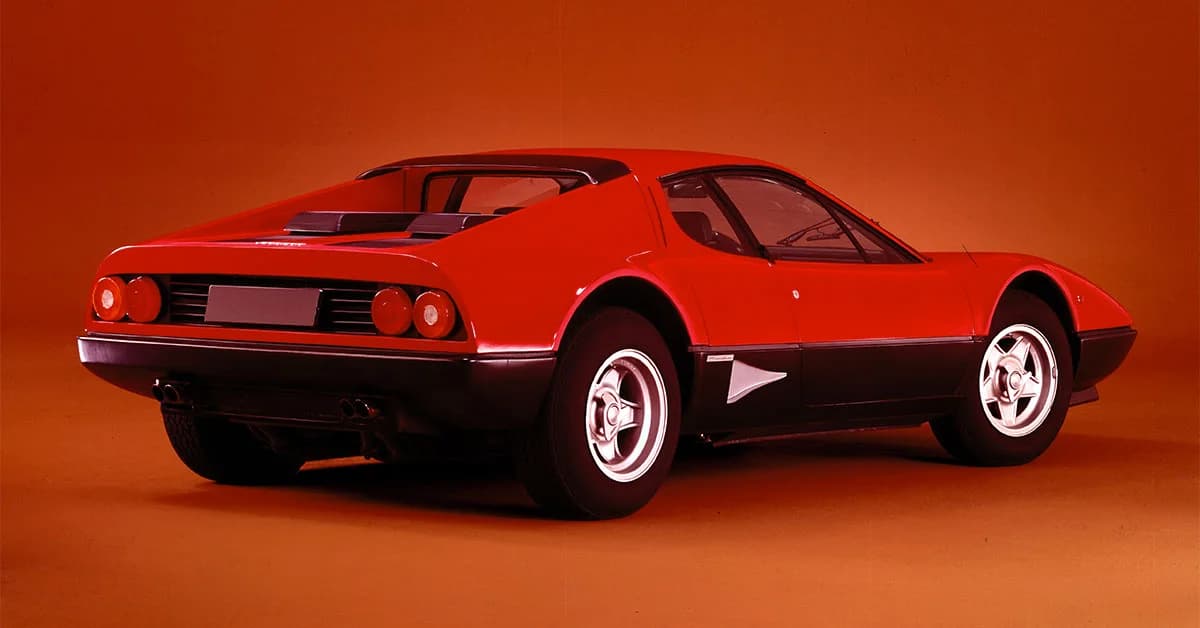
Leonardo Fioravanti's Pininfarina body gained a chin spoiler, NACA ducts ahead of the rear wheels, a wider rear track and two round tail lamps a side instead of three, and many cars wore the two-tone Boxer paint with a black lower half. Ferrari built 929 before the fuel-injected 512 BBi replaced it in 1981.
The engine is not a true boxer. Opposed pistons share crankpins, which makes it a 180-degree V12, and Mauro Forghieri, who designed the racing engine it came from, asked people not to call it a boxer. In 512 form it displaces 4,943 cc, with belt-driven camshafts, four triple-choke Weber carburetors and, new for this model, dry-sump lubrication; Ferrari quotes 340 hp, a little less than the 365 claimed, but at 6,200 rpm and with more torque, which made it easier to drive.
The engine sits above the gearbox, which kept the car short at the cost of a high center of gravity. Autocar recorded 163 mph and 6.2 seconds to 60 mph in 1978, and a racing version, the 512 BB LM, finished fifth overall at Le Mans in 1981. Judged against its era, equipment was ordinary for an exotic: air conditioning was optional on the first Boxer and standard, with power windows and a stereo, on the 512 BBi.
Ferrari never built an American version, because Enzo Ferrari judged that emissions and safety rules and a 55 mph limit left that market to his V8s. Americans bought Boxers anyway through grey-market specialists such as Dick Fritz's Amerispec, and federalizing one cost about $14,000 on average. The price given here is the 1977 British list price of £23,868, about $41,600 at that year's exchange rate, since there was never a US price.
Classic Trader's buyer's guide notes that many repairs need the engine out, that the valves want checking every 10,000 miles at €900 to €1,000 a time, and that a gearbox overhaul costs €20,000 to €25,000, and the front radiator runs its coolant pipes past the cabin. A 1979 car sold for $285,000 at Broad Arrow's Monterey sale in August 2025.
It is a purer shape than the Testarossa, which replaced the 512 BBi in 1984 and moved the radiators to the flanks to cure the heat and free up luggage space, and a more modern car than the Daytona. It is also harder to live with than either: hot, costly to service and only as good as its last major service. Its marks sit close to the Testarossa's, better on holding value, and so does its overall.
Ferrari 512 BB at a glance
Official site- Make
- Ferrari
- Model
- 512 BB
- Model year
- 1976
- Body type
- Coupe
- Powertrain
- Naturally aspirated 4.9L flat-12 with four Weber carburetors and dry sump, 5-speed manual, rear-wheel drive
- Price
- 41600
What’s your grade?
Grade by category
No account needed. Sign in so your grades follow you and count once. · how vote integrity works
Comments
Plain text, 500 characters. Be sharp, not cruel.
No comments yet. Have the first take.