Ferrari 308 GTB Review
1975308 GTBCar
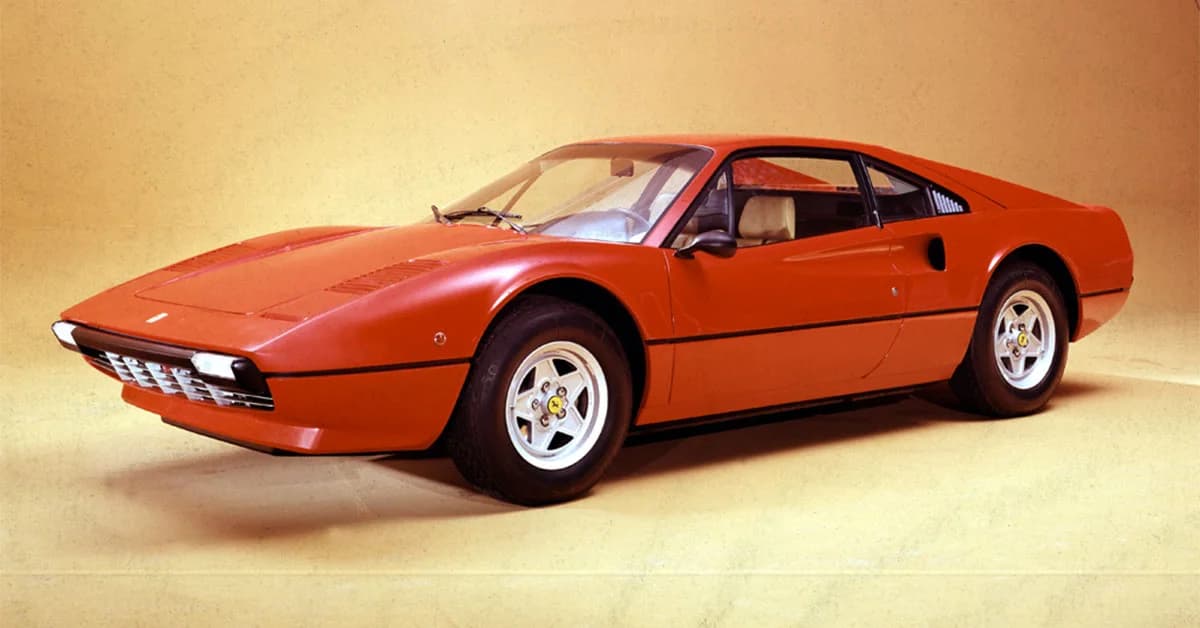
Fioravanti's shape and a carbureted V8 made the 308 GTB the template for Ferrari's mid-engined V8 cars, and the early fiberglass cars are the purest of them.
| Category | Critic | Users |
|---|---|---|
| Exterior | Exceptional | |
| Interior luxury | Average | |
| Features | Weak | |
| Reliability | Average | |
| Economy | Weak | |
| Depreciation | Great | |
| Maintenance cost | Average | |
| Innovation | Average | |
| Engine | Great | |
| User experience | Good | |
| Overall | Great |
The 308 GTB replaced the Dino 246 GT at the 1975 Paris show and set the pattern for the mid-engined V8 berlinettas that followed it, through the 328 and F355 to the 458. Leonardo Fioravanti drew it at Pininfarina, and Ferrari's own history lists what carried over from the Dino: the scalloped intakes in the doors, the twin round tail lights and the concave rear window set between buttresses. Scaglietti built the bodies, and on the first cars they were fiberglass apart from an aluminum front lid, the first time Ferrari had used the material for a production body. Steel took over in late 1976 for American cars and in mid 1977 in Europe, adding about 150 kg.
Underneath it was close kin to the Bertone-styled 308 GT4 2+2: a steel tube frame and the same 2.9 liter V8 mounted crosswise, with belt-driven twin camshafts per bank and four twin-choke Weber carburetors in the vee. European cars had dry sump lubrication and 252 hp at 7,700 rpm; American cars kept the GT4's wet sump and gave up about 15 hp to emissions equipment.
Ferrari quotes 1,090 kg dry and 157 mph. The steering is unassisted and the five-speed dog-leg gearbox sits below and behind the engine. evo's buying guide describes a shift that is notchy and reluctant to find second until the oil warms, and handling that leans toward understeer but stays very stable in fast corners. Michelotto turned it into a rally car, and the Pozzi team won the Tour de France Automobile with it in 1981 and 1982.
By Ferrari standards it is not expensive to keep running. evo puts a basic service at around £900, with cam belts due every other service for about £750 more. Rust is the real enemy: steel cars rot along the lower panels and the fronts of the sills, and poor drainage can hide corrosion on the fiberglass cars too. The carburetors need regular balancing, the sodium-filled valves of the two-valve engines have been known to fail where the head meets the stem, and a car left unused can seize the clutch plates of its limited-slip differential. It cost about $28,600 in America in 1976. evo now puts steel GTBs at £75,000 to £95,000 and the fiberglass cars at £150,000 or more.
The GTB's overall mark sits above the average of its category scores, and deliberately so. Its cabin is plain, its equipment is that of a 1975 sports car and its running gear came from the GT4, and those marks say so. What lifts it is a shape that still looks right fifty years on and a willing carbureted V8; Sports Car International ranked the 308 fifth among the sports cars of the 1970s. The targa GTS that followed in 1977 became the famous one, thanks to Tom Selleck in Magnum, P.I., but the fiberglass GTB is the lightest and purest 308 of all.
Ferrari 308 GTB at a glance
Official site- Make
- Ferrari
- Model
- 308 GTB
- Model year
- 1975
- Body type
- Coupe
- Powertrain
- 2.9L V8 with four Weber carburetors, 5-speed manual, rear-wheel drive
- Price
- 28585
What’s your grade?
Grade by category
No account needed. Sign in so your grades follow you and count once. · how vote integrity works
Comments
Plain text, 500 characters. Be sharp, not cruel.
No comments yet. Have the first take.