Ferrari 275 GTB/4 Review
1966275 GTB/4Car
The first four-cam road Ferrari put a racing-bred V12 into the 275's transaxle chassis and made the best-balanced front-engined berlinetta of its decade.
| Category | Critic | Users |
|---|---|---|
| Exterior | Exceptional | |
| Interior luxury | Average | |
| Features | Weak | |
| Reliability | Average | |
| Economy | Weak | |
| Depreciation | Exceptional | |
| Maintenance cost | Weak | |
| Innovation | Good | |
| Engine | Great | |
| User experience | Great | |
| Overall | Great |
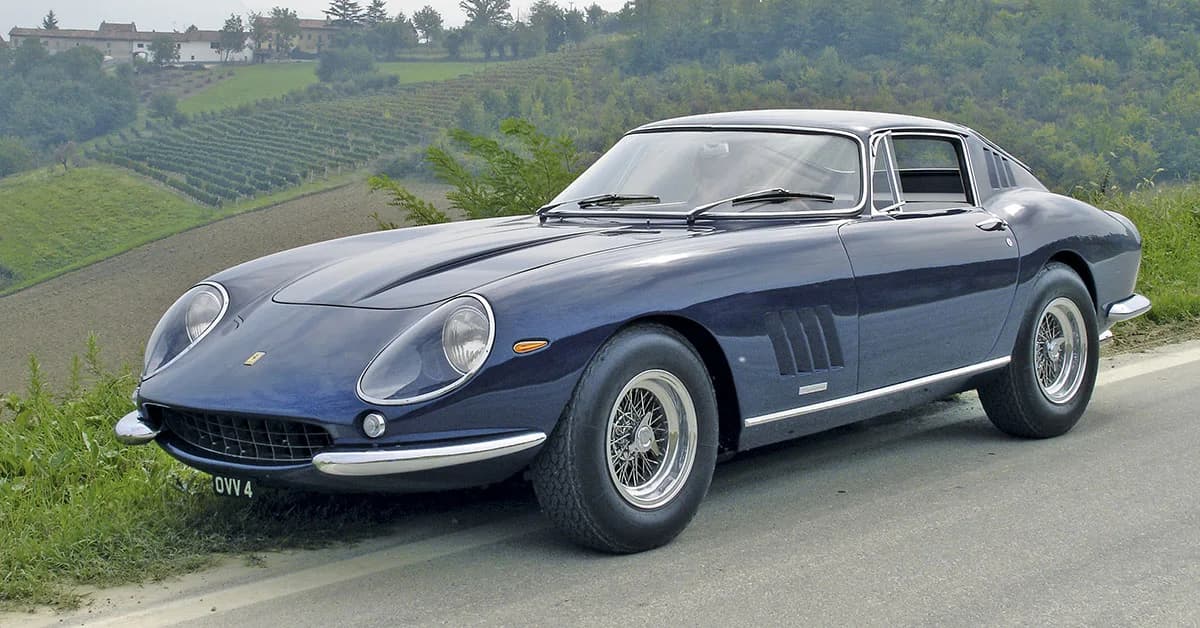
The 275 GTB/4 was the last step of the 275 line, shown at the Paris Salon in October 1966 to replace the two-cam 275 GTB. The big change was under the bonnet: the 3.3 liter V12 got two camshafts per bank, the first four-cam engine in a Ferrari road car, and in Ferrari's words the car was derived directly from the P2 racing prototype. The body stayed the late 275 GTB's long-nose shape, drawn by Pininfarina and built by Scaglietti in steel with aluminum doors, bonnet and boot lid, and the easy tell is a slim bulge along the bonnet. Production ran until March 1968, cut short after a year and a half by new American safety rules, and Ferrari built 330, about 16 of them with all-aluminum bodies.
The engine is the Tipo 226, 3,286 cc, with six Weber 40 DCN carburetors and dry-sump lubrication, rated at 300 hp at 8,000 rpm. It drives through a torque tube to a five-speed transaxle, and the rear wheels are independently sprung on wishbones and coil springs, two things the 275 series had introduced to Ferrari road cars in 1964. Ferrari quotes 268 km/h, about 167 mph, and 1,100 kg dry. In a 2024 Classic & Sports Car feature marking the 275's 60th year, Simon Hucknall found the four-cam stronger and more linear at low and middle revs, with a more fluid gearchange, and called it the most confidence-inspiring of the three cars he drove.
Buyers who wanted comfort had the quieter 330 GTC on the same chassis; this is the sporting berlinetta, and its equipment was plain even for 1966. Luigi Chinetti had ten open versions built for America, and Road & Track called one the most satisfying sports car in the world in 1967.
Steve McQueen bought one new in late 1967 while filming Bullitt, and Ferrari's records, quoted by RM Sotheby's, show Chinetti's American price was $14,400 against a factory price of $8,244; that car sold for $10,175,000 in 2014. An ordinary coupe is worth about a third of that: Bonhams sold a 1967 car in Switzerland in June 2025 for CHF 2,875,000, about $3.6 million, and one of the open NART Spiders made $27.5 million in 2013. Upkeep is serious. Six carburetors need balancing, the dry-sump engine and the transaxle are specialist work, and Sports Car Market lists a tune-up at $3,500 before any of the restoration a car this valuable eventually needs.
Between the SWB before it and the Daytona after it, the 275 GTB/4 is arguably the best balanced of Ferrari's front-engined berlinettas, pairing the transaxle's weight distribution, independent rear suspension and a V12 that pulls to 8,000 rpm with a body that has not dated. Motor Trend Classic ranked the 275 GTB and GTS third among the greatest Ferraris. The category marks carry the costs of a 1960s V12 and a spare cabin; the way it drives is why it ranks among the best road Ferraris.
Ferrari 275 GTB/4 at a glance
Official site- Make
- Ferrari
- Model
- 275 GTB/4
- Model year
- 1966
- Body type
- Coupe
- Powertrain
- Naturally aspirated 3.3L four-cam V12 with six Weber carburetors and dry sump, 5-speed manual transaxle, rear-wheel drive
- Price
- 14400
What’s your grade?
Grade by category
No account needed. Sign in so your grades follow you and count once. · how vote integrity works
Comments
Plain text, 500 characters. Be sharp, not cruel.
No comments yet. Have the first take.