Ferrari 250 GTO Review
1962250 GTOCar
An old chassis under a body shaped in a wind tunnel won Ferrari three GT titles in a row and became the most coveted Ferrari ever built.
| Category | Critic | Users |
|---|---|---|
| Exterior | Exceptional | |
| Interior luxury | Weak | |
| Features | Avoid | |
| Reliability | Average | |
| Economy | Weak | |
| Depreciation | Exceptional | |
| Maintenance cost | Avoid | |
| Innovation | Good | |
| Engine | Exceptional | |
| User experience | Good | |
| Overall | Great |
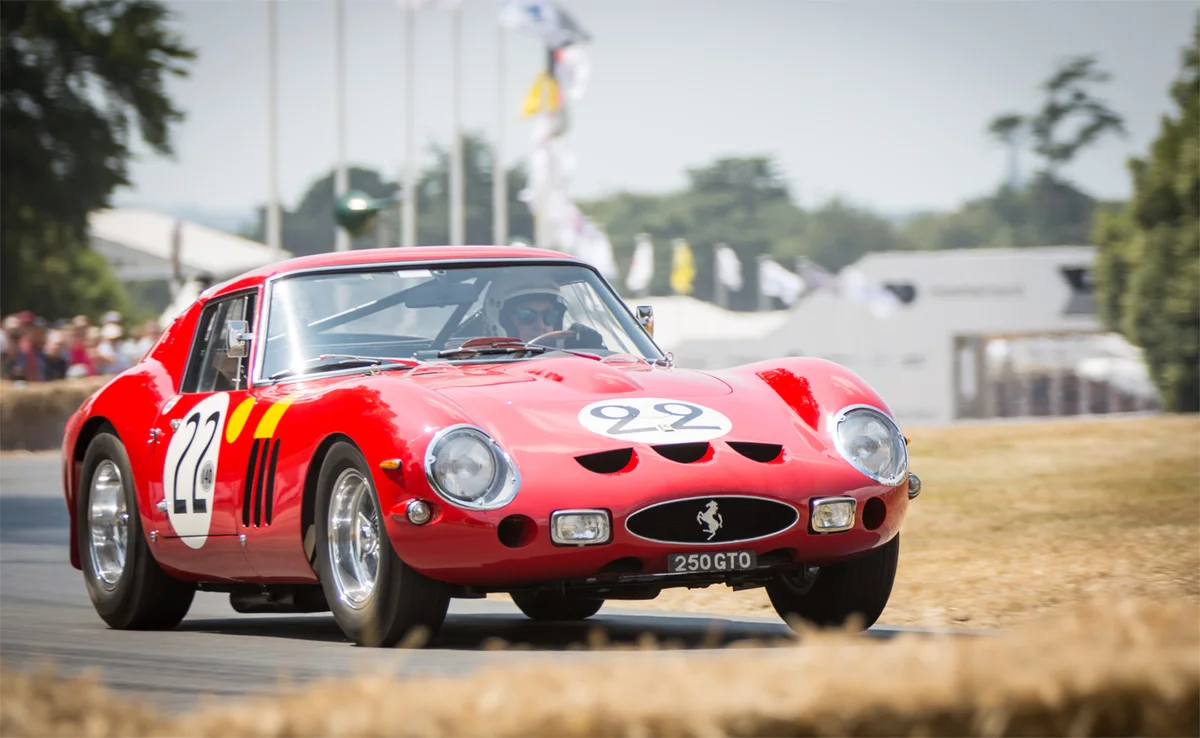
The GTO was built to win the GT championship the FIA created for 1962, and it got there through a loophole. Group 3 required 100 cars in a year, but Ferrari had the GTO accepted as an evolution of the already homologated 250 GT SWB and built just 36: 33 with the original body and three with a 1964 body, with four earlier cars rebodied to match. The story of Enzo Ferrari moving the same cars around to fool the inspectors is a myth, since no trick was needed.
Giotto Bizzarrini began the project on an SWB chassis, and his rough prototype, nicknamed Il Mostro, lapped Monza faster than an SWB could with Stirling Moss at the wheel in September 1961. Bizzarrini was pushed out in the palace revolt later that year, and Scaglietti, working with Mauro Forghieri, finished a body shaped by wind tunnel tests at the University of Pisa.
Mechanically it was conservative on purpose. The 2,953 cc Colombo V12 is in Testa Rossa specification, with dry-sump lubrication and six Weber carburetors, and makes about 300 hp at 7,500 rpm; it drives a new five-speed gearbox, shifted through the open metal gate that became a Ferrari signature, and a live rear axle located by a Watt's linkage.
The cabin has cloth seats and no carpet, headliner or speedometer. On its debut at Sebring in March 1962, Phil Hill and Olivier Gendebien finished second overall and won the GT class. Ferrari won the over two liter division of the GT manufacturers' championship in 1962, 1963 and 1964, and GTOs won the Tour de France Automobile and the Tourist Trophy twice each and the GT class at Le Mans in 1962 and 1963.
It cost $18,000 in America, where Enzo Ferrari and Luigi Chinetti approved the buyers. By the late 1960s it was an obsolete racer that changed hands for four-figure sums. Today the auction record for any Ferrari is the $51,705,000 paid at RM Sotheby's New York sale in November 2023 for chassis 3765, and the only GTO the factory finished in white made $38.5 million at Mecum's Kissimmee sale in January 2026; a private sale in 2018 was reported at $70 million. Running one is race-shop work, with Sports Car Market putting a tune-up at $5,500 and up, and replicas built on lesser 250 chassis mean the paperwork has to be checked as closely as the car.
Motor Trend Classic named it the greatest Ferrari of all time, and Sports Car International named it the top sports car ever made. Judged strictly, it is a race car with a bare cabin, a live axle and costs no ordinary owner can plan for, and its category marks say so. Ferrari's own history calls it perhaps the last dual-purpose road and race car; its engine, its shape and its record put it at the top of the Ferrari canon, and only the ownership experience keeps the overall a step short.
Ferrari 250 GTO at a glance
Official site- Make
- Ferrari
- Model
- 250 GTO
- Model year
- 1962
- Body type
- Coupe
- Powertrain
- Naturally aspirated 3.0L V12 with six Weber carburetors and dry sump, 5-speed manual, rear-wheel drive
- Price
- 18000
What’s your grade?
Grade by category
No account needed. Sign in so your grades follow you and count once. · how vote integrity works
Comments
Plain text, 500 characters. Be sharp, not cruel.
No comments yet. Have the first take.