Ferrari 250 GT SWB Berlinetta Review
1959250 GT SWB BerlinettaCar
Ferrari's most complete dual-purpose GT: civil enough to drive on the road, and quick enough to win the Tourist Trophy twice for Stirling Moss.
| Category | Critic | Users |
|---|---|---|
| Exterior | Exceptional | |
| Interior luxury | Average | |
| Features | Weak | |
| Reliability | Average | |
| Economy | Weak | |
| Depreciation | Exceptional | |
| Maintenance cost | Weak | |
| Innovation | Good | |
| Engine | Great | |
| User experience | Great | |
| Overall | Great |
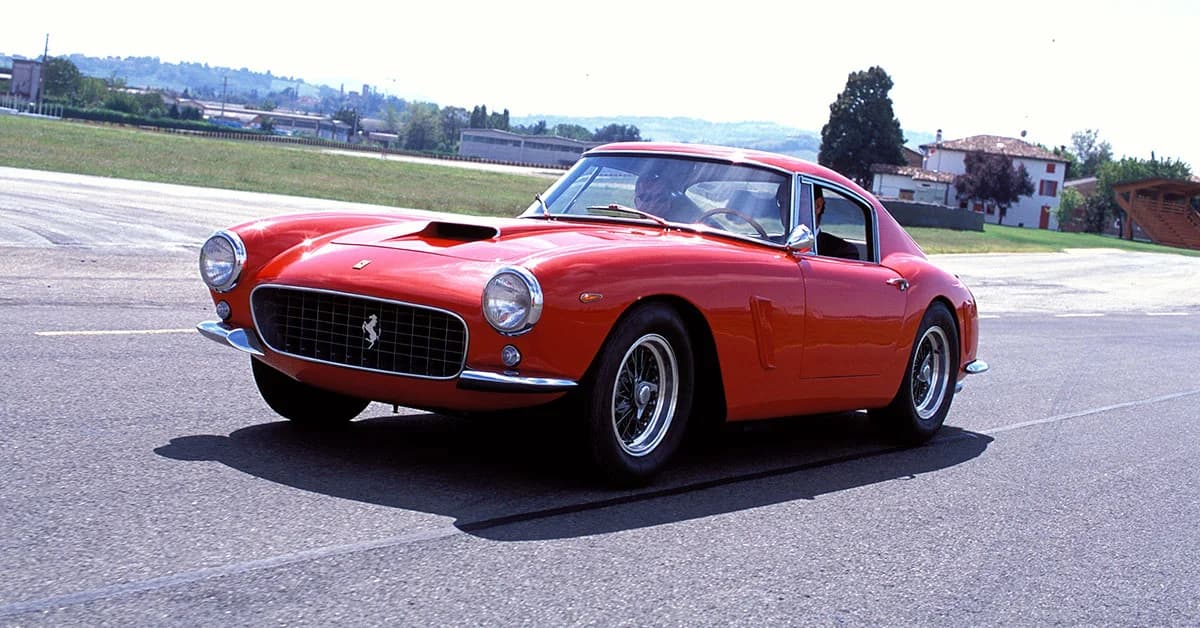
Ferrari showed the short-wheelbase 250 GT Berlinetta at the Paris Salon in October 1959, and its purpose was a road car that could win races without being rebuilt. The wheelbase came down by 200 mm to 2,400 mm, Pininfarina drew a tauter body that Scaglietti built, and the engineers who developed it, among them Carlo Chiti and Giotto Bizzarrini, went on to produce the 250 GTO.
It was the first Ferrari production road car with disc brakes as standard and the first 250 berlinetta offered with right-hand drive. Buyers chose a competition car, with an aluminum body and a hotter engine, or a Lusso in steel with aluminum opening panels, and plenty mixed the two. Sports Car Market counts 165 built, 90 in steel and 75 in aluminum.
The engine is the 2,953 cc Colombo V12 with a single camshaft per bank and three twin-choke Weber carburetors, rated by Ferrari at 220 to 280 hp depending on specification. It drives a four-speed all-synchromesh gearbox and a live rear axle on leaf springs. Ferrari's own history says colder spark plugs, racing tires and a roll bar were enough to turn a road car into a class contender, and the results bear it out: Stirling Moss won the Tourist Trophy at Goodwood in 1960 and 1961 in SWBs, the model won the Tour de France Automobile three years running from 1960, and it took the GT class of the 1961 manufacturers' championship. Ferrari described it at the time as a car for touring as well as racing, with space for luggage and a heating system, which, judged against its era, was about the extent of its equipment.
Ownership now is a specialist's job at a collector's price. The car listed at about $12,000 in America. Sports Car Market's 2023 valuation for steel cars ran from $6.9 million to $13 million, and that year RM Sotheby's sold a 1961 car at Lake Como for €6,586,250, about $7.1 million; cars with strong racing histories bring more. Many SWBs were raced hard, crashed and rebodied, so documentation carries the value: Ferrari Classiche certification, the factory build sheets and an original engine, gearbox and differential, which Gooding Christie's called a rare distinction among SWBs when it offered one in Paris in January 2026. The Colombo V12 and the four-speed box are robust and well understood, but routine work is priced like restoration work, and Sports Car Market lists a tune-up at $3,500 and up.
The SWB is the link between Ferrari's 1950s road racers and the GTO, and as a road car it is the more usable of the two, since the Lusso versions were built for the street from the start. Motor Trend Classic ranked it fifth among the greatest Ferraris. Its category marks carry a 1959 cabin and the running costs of a multimillion-dollar car; its shape, its engine and the way it drives are why it sits near the top of the list.
Ferrari 250 GT SWB Berlinetta at a glance
Official site- Make
- Ferrari
- Model
- 250 GT SWB Berlinetta
- Model year
- 1959
- Body type
- Coupe
- Powertrain
- Naturally aspirated 3.0L V12 with three Weber carburetors, 4-speed manual, rear-wheel drive
- Price
- 12000
What’s your grade?
Grade by category
No account needed. Sign in so your grades follow you and count once. · how vote integrity works
Comments
Plain text, 500 characters. Be sharp, not cruel.
No comments yet. Have the first take.