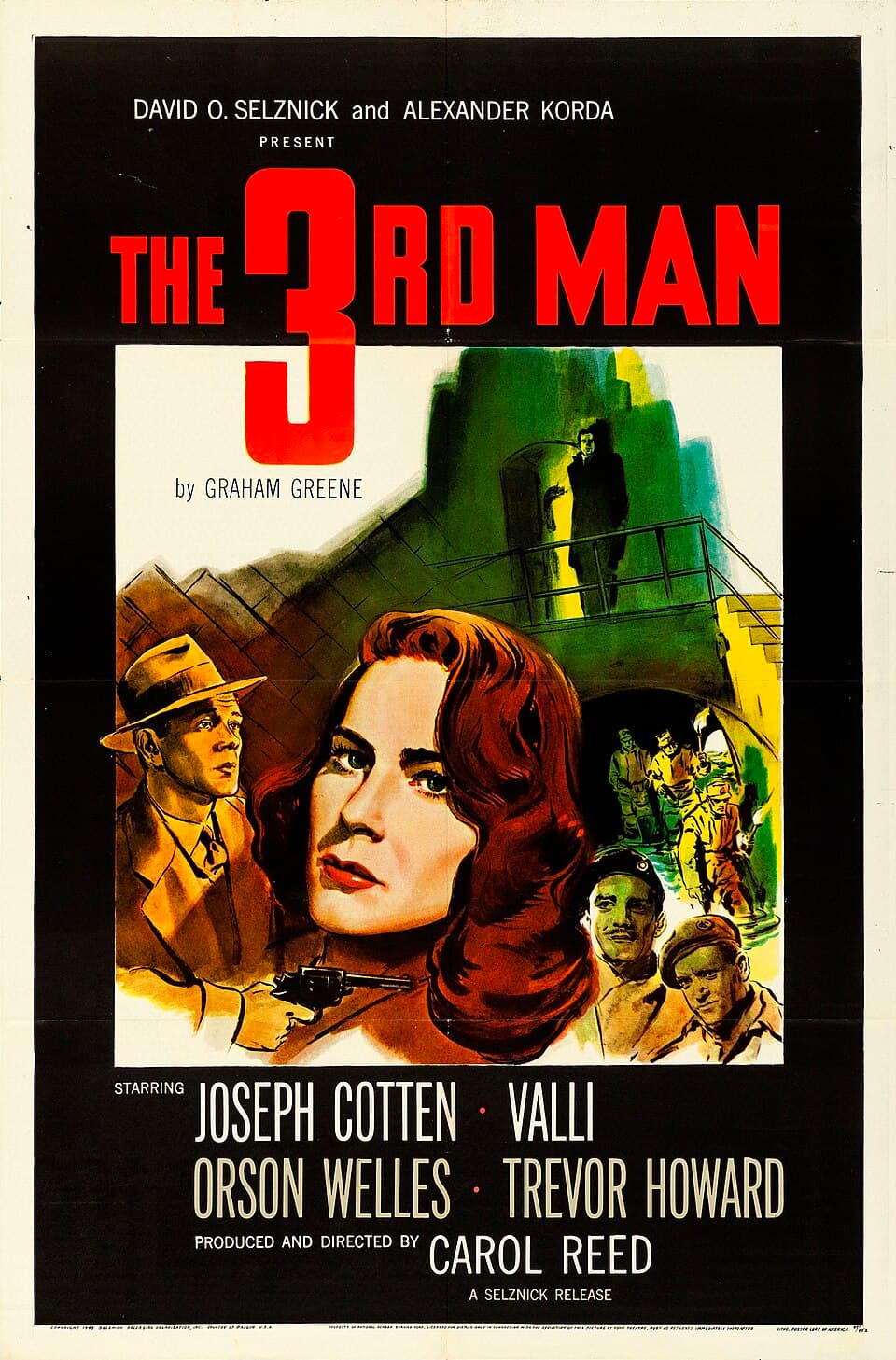
The Third Man Review
1949Carol ReedMovie
Carol Reed's tilted, rubble-strewn Vienna is the most atmospheric city in film noir, set to a zither tune that went to number one.
| Category | Critic | Users |
|---|---|---|
| Plot | Great | |
| Cinematography | Exceptional | |
| Acting | Great | |
| Dialogue | Great | |
| Overall | Great |
Reed shot for six weeks in a Vienna still divided among four occupying powers, with four camera units working around the clock, and Robert Krasker lit the rubble and wet cobbles at Dutch angles so steep that William Wyler sent Reed a spirit level as a joke. The tilt is the moral climate of a city where everyone is selling something and nothing stands straight, and Krasker won the Oscar for it.
Graham Greene's script makes Joseph Cotten's Holly Martins, a writer of cheap westerns, into an amateur detective in a plot he cannot read, with Trevor Howard's weary Major Calloway correcting him at every turn. Alida Valli, as Lime's grieving girlfriend, gives the film its gravity. Orson Welles is on screen for a fraction of the running time and dominates it, above all on the Prater Ferris wheel, ending with the cuckoo clock speech Greene said Welles wrote himself.
Anton Karas, an unknown zither player from Vienna's wine taverns, gave the film its sound, and his theme spent eleven weeks at number one in America. See the 104 minute British cut with Reed's opening narration, not Selznick's shorter American version. The sewer chase is as good as noir gets, and so is the last shot, one long take down an avenue of trees.
The Third Man at a glance
- Director
- Carol Reed
- Runtime
- 104 min
- Release year
- 1949
What’s your grade?
Grade by category
No account needed. Sign in so your grades follow you and count once. · how vote integrity works
Comments
Plain text, 500 characters. Be sharp, not cruel.
No comments yet. Have the first take.