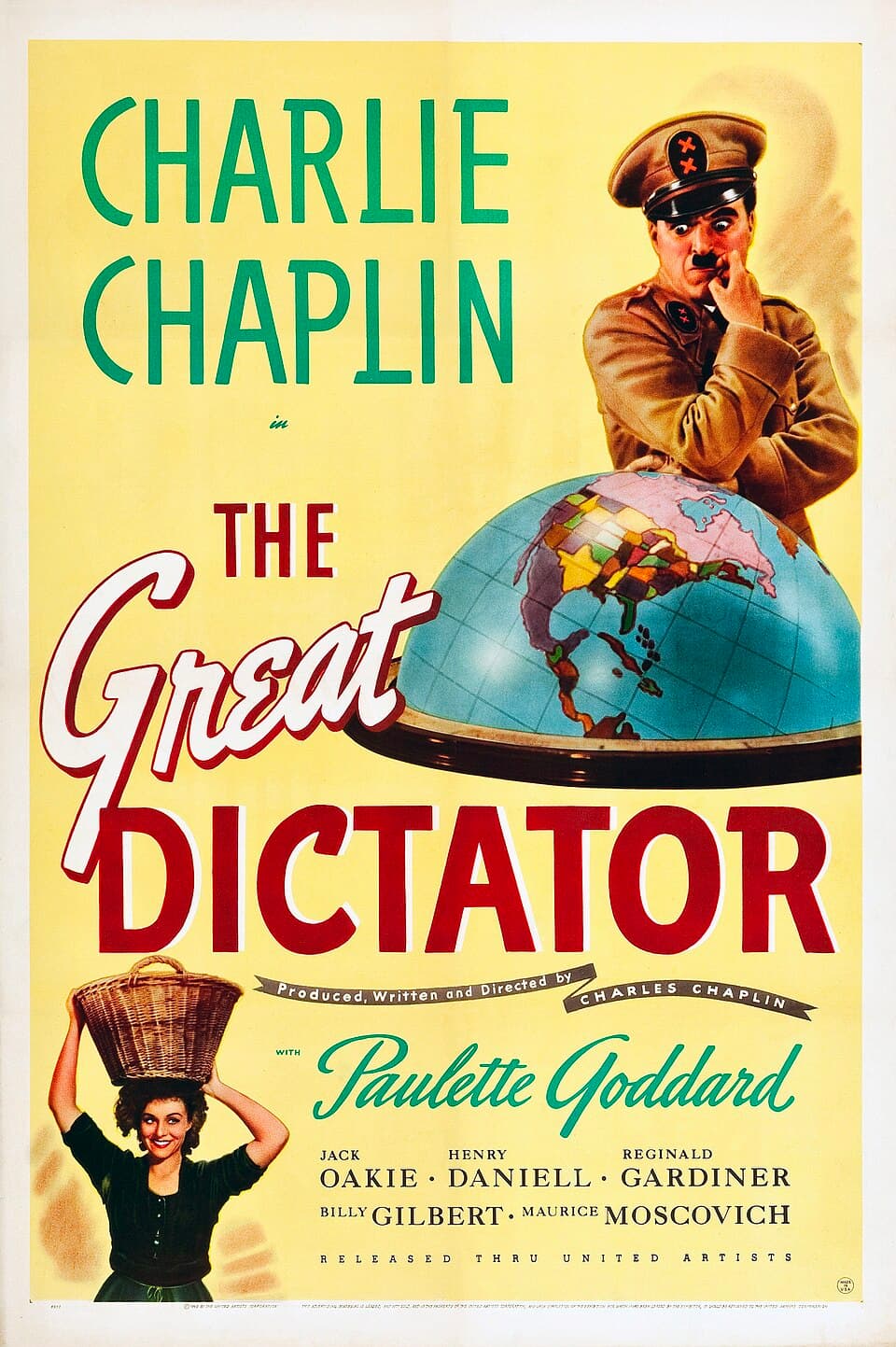
The Great Dictator Review
1940Charlie ChaplinMovie
Chaplin's first talkie mocks Hitler to his face while America was still neutral, and its closing speech is both its bravest moment and its weakest.
| Category | Critic | Users |
|---|---|---|
| Plot | Good | |
| Cinematography | Good | |
| Acting | Great | |
| Dialogue | Good | |
| Overall | Great |
Chaplin began shooting in September 1939, six days after the war started, with studio executives, the British censors and the German consul all trying to stop him. As Adenoid Hynkel he turns Hitler's oratory, studied from newsreels and Triumph of the Will, into German-sounding gibberish, and the rally speech is vocal slapstick nobody has matched. As the Jewish barber he stays nearly silent, a cousin of the Tramp, shaving a customer in time to Brahms.
The best sequence has no words at all: Hynkel alone with a balloon globe, dancing it into the air to the Lohengrin prelude until it bursts. Jack Oakie, Oscar nominated as the rival dictator Benzino Napaloni, turns a summit buffet into a food fight. The camera work is plain, and the ghetto scenes with Paulette Goddard's Hannah run slow and sentimental.
The finale puts the barber at a microphone, and Chaplin steps out of the story to address the audience. The speech is sincere and much sampled, and it stops the comedy dead; Chaplin was brilliant with nonsense and stiff with sermons, which is where the dialogue mark lands. He later wrote that he could not have made it had he known the full extent of the Nazi crimes. That he made it when he did is why it matters.
The Great Dictator at a glance
- Director
- Charlie Chaplin
- Runtime
- 125 min
- Release year
- 1940
What’s your grade?
Grade by category
No account needed. Sign in so your grades follow you and count once. · how vote integrity works
Comments
Plain text, 500 characters. Be sharp, not cruel.
No comments yet. Have the first take.