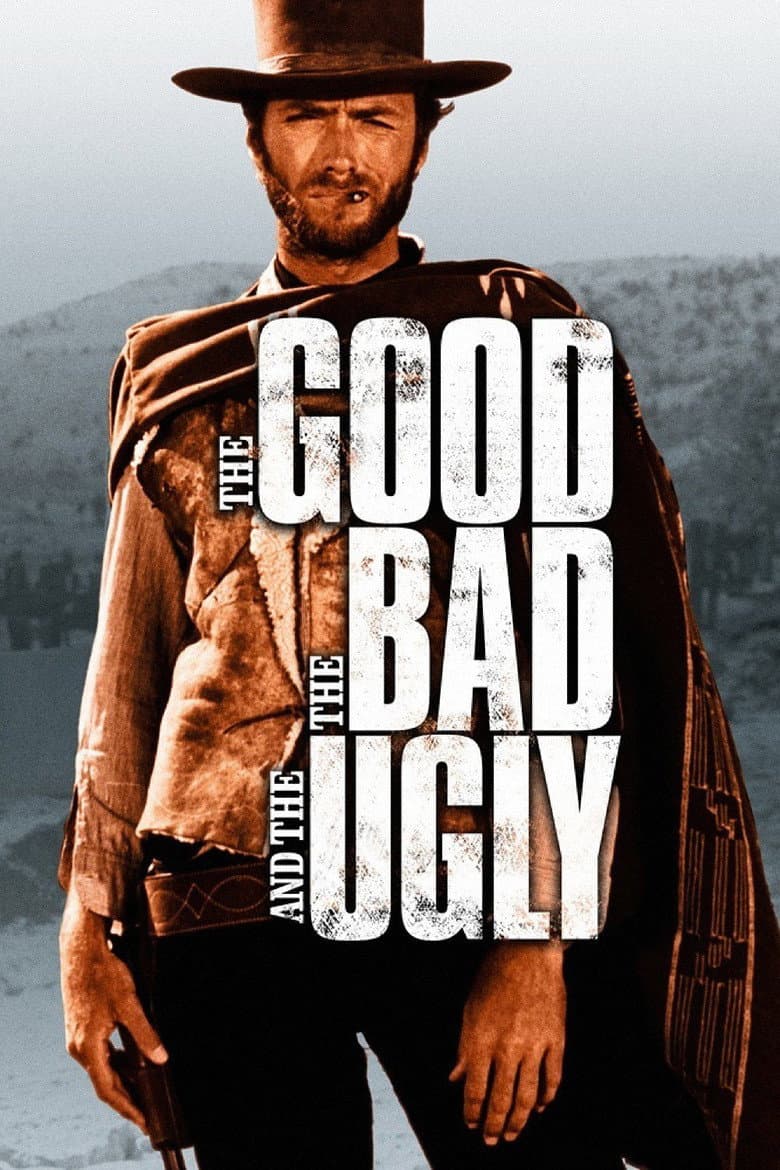
The Good, the Bad and the Ugly Review
1966Sergio LeoneMovie
Leone's widescreen opera of greed; faces like landscapes, landscapes like faces.
| Category | Critic | Users |
|---|---|---|
| Plot | Great | |
| Cinematography | Exceptional | |
| Acting | Great | |
| Dialogue | Good | |
| Overall | Great |
Sergio Leone's epic is a grammar lesson the movies never stopped quoting: extreme widescreen vistas smash-cut against eyeball close-ups, faces treated as terrain and terrain as character. The plot is a lean treasure hunt, three killers converging on two hundred thousand dollars in Confederate gold, but Leone stretches it across a Civil War rendered with unexpected moral seriousness; the bridge battle and the prison-camp orchestra, forced to play while men are beaten, give the pulp real historical weight.
Eli Wallach's Tuco is the film's engine and its soul, garrulous, treacherous, and weirdly sympathetic, running the famous three-way graveyard standoff against Clint Eastwood's silence and Lee Van Cleef's reptilian stillness. That finale, Ennio Morricone's Ecstasy of Gold spinning the camera through the graves and then the trumpet-scored geometry of three men, three guns, and one name under a rock, is the most imitated climax in the medium.
The costs are era-typical: post-dubbed dialogue that lands functional rather than quotable in English, a midsection that wanders, and performances pitched to opera rather than intimacy. As pure cinema, sound, image, and montage doing the storytelling, it remains a summit.
The Good, the Bad and the Ugly at a glance
- Director
- Sergio Leone
- Runtime
- 161 min
- Rating
- R
- Release year
- 1966
What’s your grade?
Grade by category
No account needed. Sign in so your grades follow you and count once. · how vote integrity works
Comments
Plain text, 500 characters. Be sharp, not cruel.
No comments yet. Have the first take.