
On the Waterfront Review
1954Elia KazanMovie
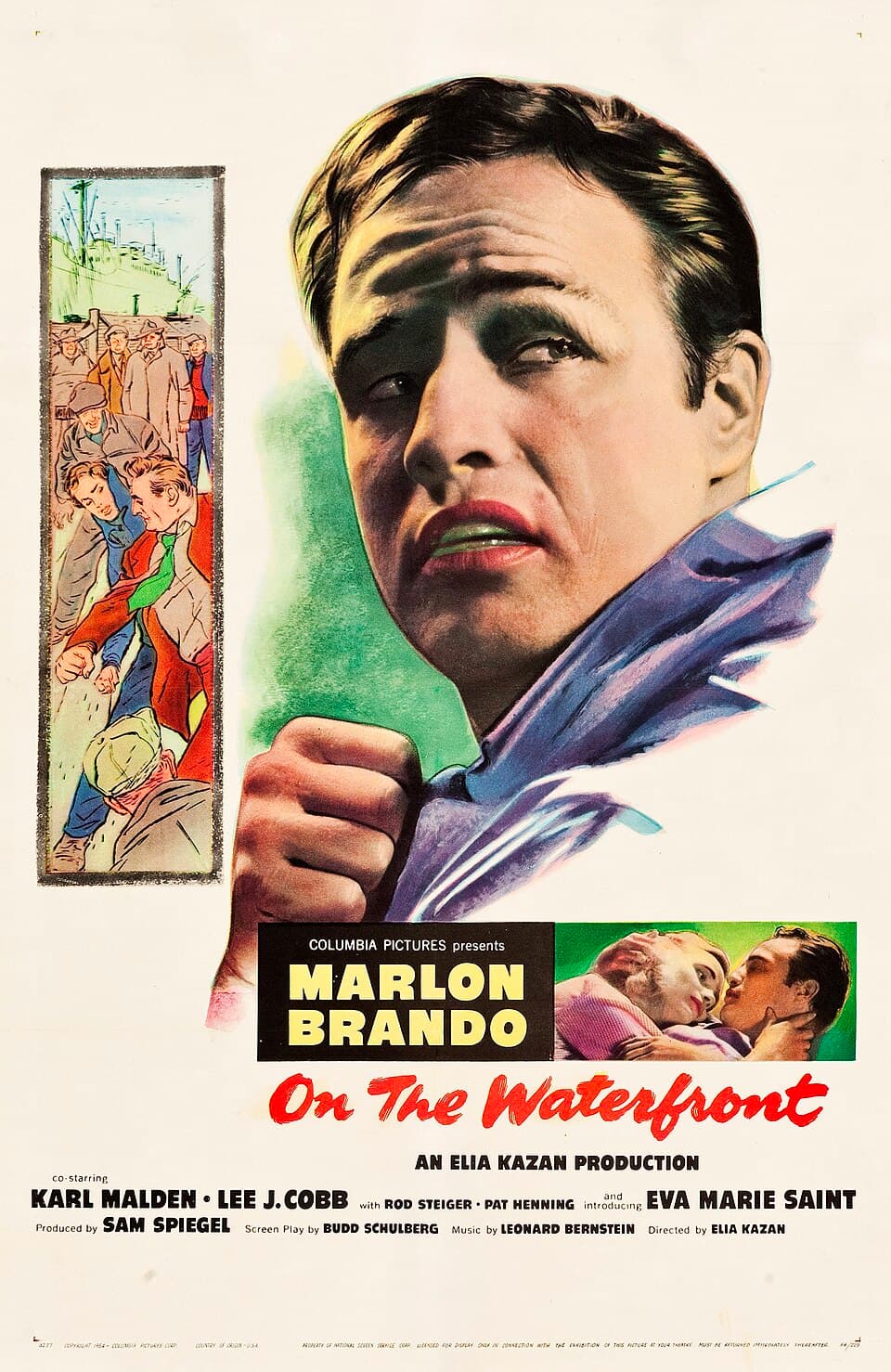
Brando's Terry Malloy rewrote screen acting inside a film that doubles as Elia Kazan's defense of informing, and both facts are on the screen.
| Category | Critic | Users |
|---|---|---|
| Plot | Great | |
| Cinematography | Great | |
| Acting | Exceptional | |
| Dialogue | Great | |
| Overall | Great |
Kazan shot it in thirty-six days on Hoboken's docks, rooftops and bars, and Boris Kaufman's photography has a cold documentary grain no studio could fake. Budd Schulberg spent two years around the docks, and the corruption is procedural rather than operatic: the shape-up where work is a favor, the loan sharks, the code of silence.
Brando is why it endures. His Terry Malloy is an ex-boxer told he is stupid so often that he performs it, and the performance lives in evasions: the glove Eva Marie Saint drops in the park that he pulls onto his own hand, his rooftop pigeons, and the taxi scene with Rod Steiger, where "I coulda been a contender" arrives as a grievance against a brother rather than a speech. Karl Malden, Lee J. Cobb and Steiger were all Oscar-nominated, and the film won eight Oscars, including picture, director, actor and supporting actress for Saint in her screen debut.
The problem is what the story is for. Kazan had named names before the House Un-American Activities Committee in 1952, and the film makes testifying the bravest act available; Orson Welles called it a celebration of the informant. Leonard Bernstein's only original film score is pushed loud, and the finale is staged as a Passion play. None of it dims Brando.
On the Waterfront at a glance
- Director
- Elia Kazan
- Runtime
- 108 min
- Release year
- 1954
What’s your grade?
Grade by category
No account needed. Sign in so your grades follow you and count once. · how vote integrity works
Comments
Plain text, 500 characters. Be sharp, not cruel.
No comments yet. Have the first take.