

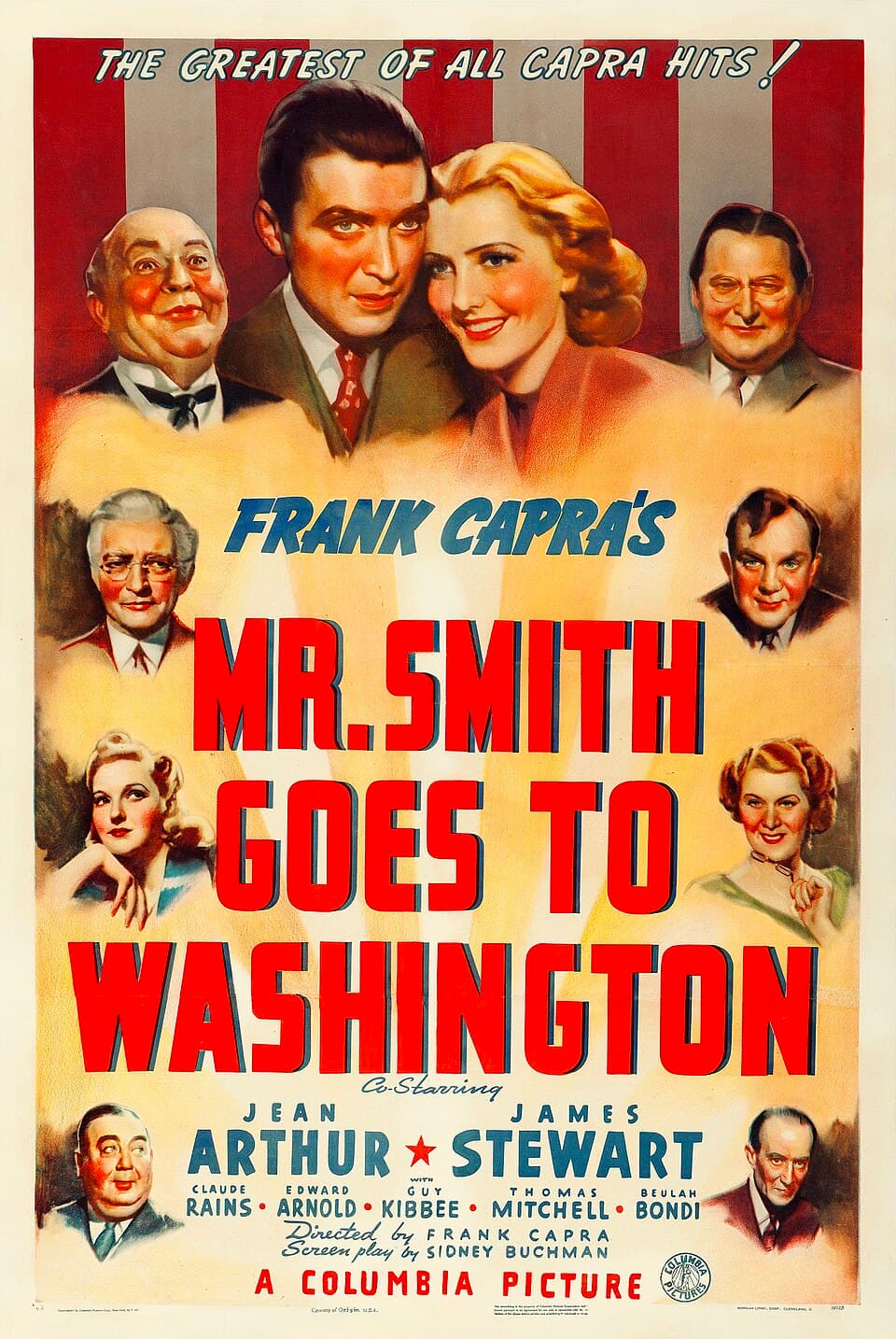
Mr. Smith Goes to Washington Review
1939Frank CapraMovie
Capra's civics lesson is corn with a knife in it, and James Stewart's hoarse, exhausted filibuster is the performance that made him a star.
| Category | Critic | Users |
|---|---|---|
| Plot | Good | |
| Cinematography | Good | |
| Acting | Great | |
| Dialogue | Great | |
| Overall | Great |
Capra built a replica of the Senate chamber on the Columbia lot, hired a former superintendent of the Senate gallery to police the protocol, and used it to show the institution bending to a political boss. Washington took it personally. The capital's press attacked it after a premiere at Constitution Hall with 45 senators among the guests, majority leader Alben Barkley called it silly and stupid, and Joseph Kennedy wanted it kept out of Europe. Hitler's Germany, Mussolini's Italy and Franco's Spain banned it instead.
It earns the fuss. Jean Arthur's Saunders, the secretary who has seen everything and talks like it, is the best written part, and Claude Rains plays the compromised Senator Paine as a man in torment rather than a villain. Sidney Buchman's script is sharp until it reaches for the Lincoln Memorial. Then Stewart takes the floor for the filibuster and talks himself hoarse, and the film becomes what it wanted to be.
The limits are Capra's. The Boy Rangers and patriotic montages are syrup, the machine's thugs beat children in a way the film treats as melodrama, and the resolution is so abrupt that the story simply stops. Of eleven Oscar nominations it won one, for Lewis R. Foster's original story; five of its losses went to Gone with the Wind.
Mr. Smith Goes to Washington at a glance
- Director
- Frank Capra
- Runtime
- 130 min
- Release year
- 1939
What’s your grade?
Grade by category
No account needed. Sign in so your grades follow you and count once. · how vote integrity works
Comments
Plain text, 500 characters. Be sharp, not cruel.
No comments yet. Have the first take.