
Judgment at Nuremberg Review
1961Stanley KramerMovie
Stanley Kramer's trial of Nazi judges is earnest to a fault, but Spencer Tracy, Maximilian Schell and the witnesses keep the lecture alive.
| Category | Critic | Users |
|---|---|---|
| Plot | Good | |
| Cinematography | Good | |
| Acting | Great | |
| Dialogue | Great | |
| Overall | Good |
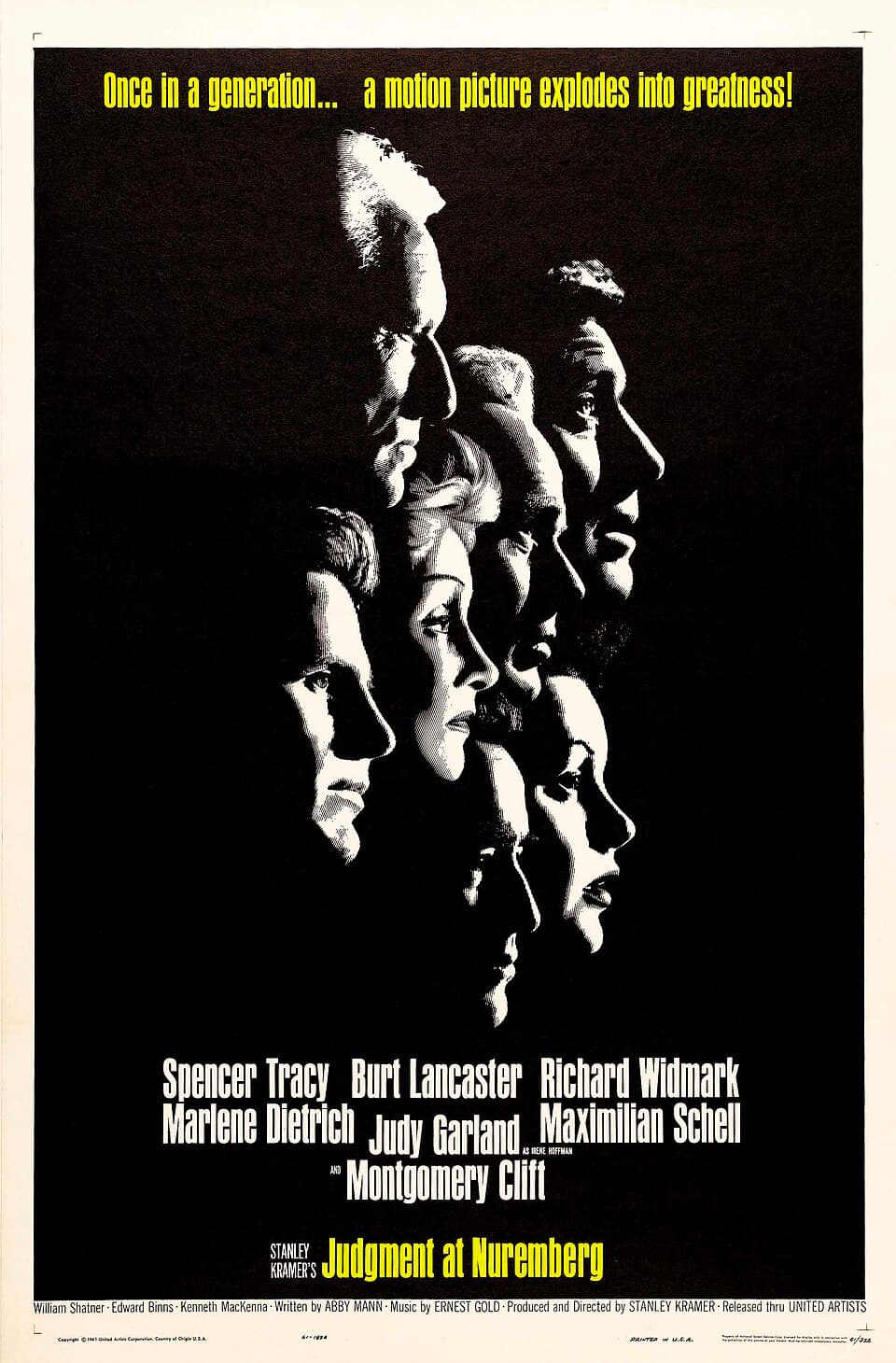
Stanley Kramer stages the Judges' Trial as a moral seminar, and the casting is the argument. Spencer Tracy's Dan Haywood is a plain American judge trying to understand how decent Germans let it happen. Burt Lancaster's Ernst Janning, the eminent jurist in the dock, barely speaks for more than two hours. And Maximilian Schell's defense counsel Hans Rolfe, who won the Oscar, makes the strongest case the film can imagine against its own premise, citing American support for eugenics, the Vatican's and Stalin's deals with Hitler, and Hiroshima.
The witnesses give the film its most affecting passages. Montgomery Clift, visibly struggling with his lines in a way that suits a man sterilized by order of the court, and Judy Garland, as a woman caught up in a race-defilement case modeled on the real Katzenberger trial, were both nominated for Oscars. Richard Widmark's prosecutor screens actual footage from the liberated camps, the first mainstream drama to show it.
The trouble is Kramer's hand. The Monthly Film Bulletin complained about the zooms and circling camera, which keep underlining points Abby Mann's Oscar-winning script has already made, and at three hours the speeches can feel like a lecture delivered twice. Tracy's closing speech, filmed in a single take with several cameras, is the payoff, and he earns it.
Judgment at Nuremberg at a glance
- Director
- Stanley Kramer
- Runtime
- 179 min
- Release year
- 1961
What’s your grade?
Grade by category
No account needed. Sign in so your grades follow you and count once. · how vote integrity works
Comments
Plain text, 500 characters. Be sharp, not cruel.
No comments yet. Have the first take.