

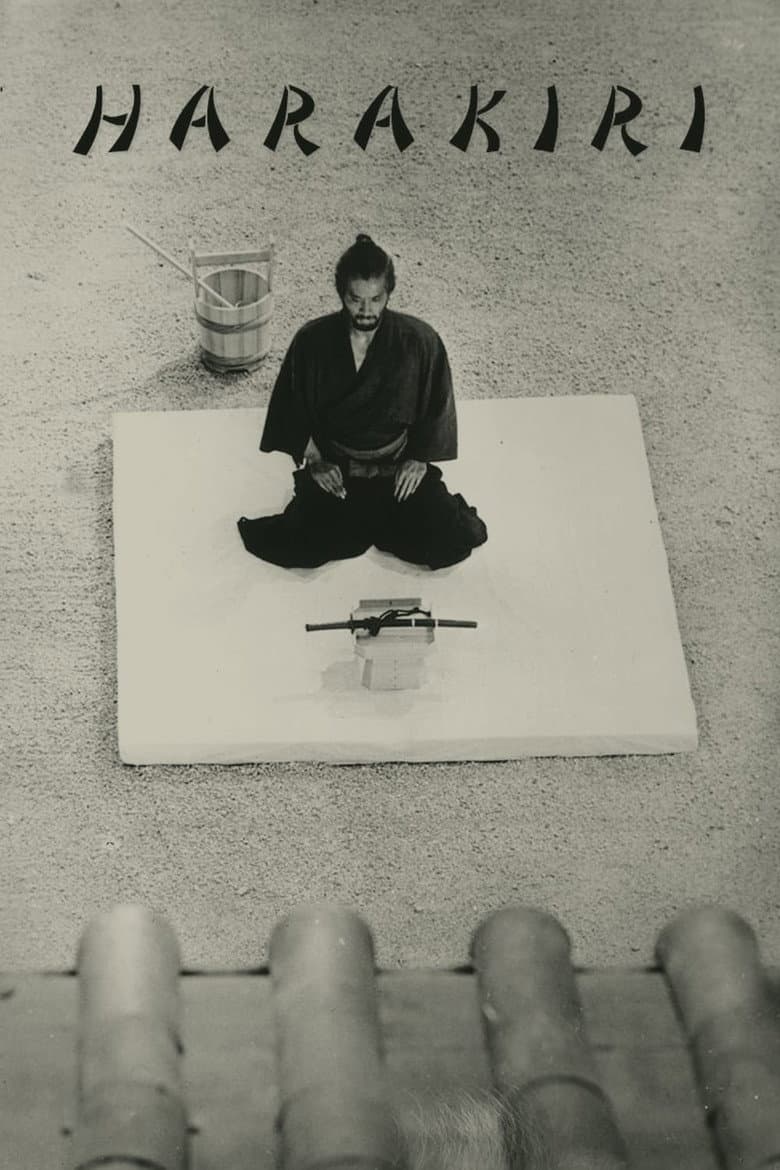
Harakiri Review
1962Masaki KobayashiMovie
A revenge film built as a legal argument, and the verdict destroys an entire code.
| Category | Critic | Users |
|---|---|---|
| Plot | Exceptional | |
| Cinematography | Great | |
| Acting | Great | |
| Dialogue | Great | |
| Overall | Great |
Kobayashi hands you a cruelty first and its meaning ninety minutes later, and that gap is the whole design. A ronin asks the Iyi clan for a courtyard in which to disembowel himself; the retainers, sure he is bluffing for alms, tell him about the last man who tried it and the bamboo sword they forced through his stomach. Only when Tatsuya Nakadai's Hanshiro Tsugumo begins his own account does the earlier scene reverse polarity, and a story of samurai firmness becomes a record of men torturing a starving boy to protect a reputation.
Yoshio Miyajima frames the Iyi compound in rigid symmetry, raked gravel and shoji grids, so the single handheld eruption of the final duel reads as the architecture itself breaking. Toru Takemitsu scores it with biwa strikes that land like accusations. Nakadai plays courtesy as a weapon, every bow another sentence in a case he is building. The villains are pure institution rather than people, which flattens them, but that is the argument: the clan survives by rewriting its own ledger, polishing the armor and recording no deaths at all.
Harakiri at a glance
- Director
- Masaki Kobayashi
- Runtime
- 133 min
- Rating
- Not Rated
- Where to watch
- The Criterion Channel
- Release year
- 1962
What’s your grade?
Grade by category
No account needed. Sign in so your grades follow you and count once. · how vote integrity works
Comments
Plain text, 500 characters. Be sharp, not cruel.
No comments yet. Have the first take.