
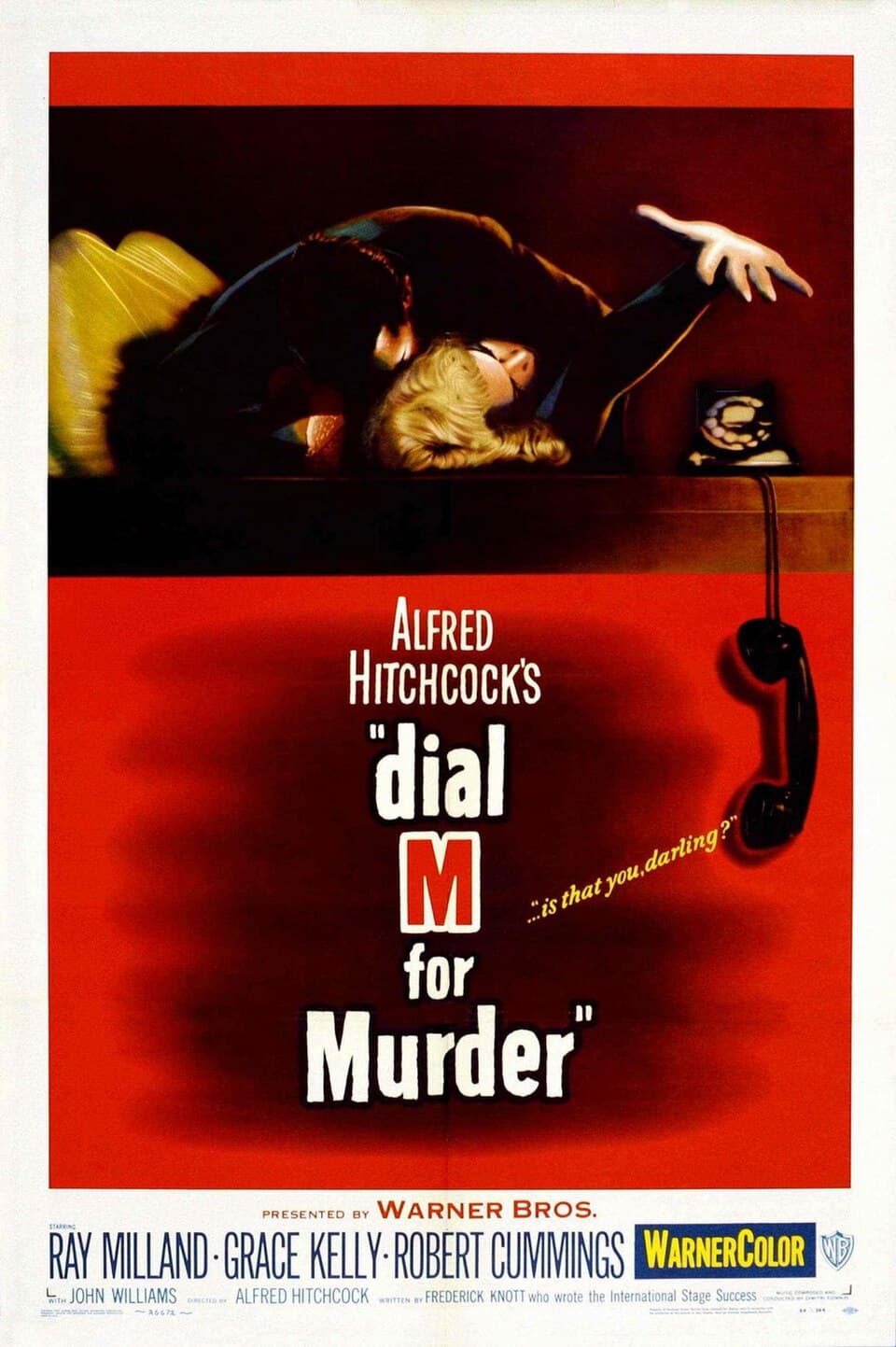
Dial M for Murder Review
1954Alfred HitchcockMovie
Hitchcock barely leaves one London flat and lets Frederick Knott's clockwork murder plot do the work: filmed theater, but superior filmed theater.
| Category | Critic | Users |
|---|---|---|
| Plot | Great | |
| Cinematography | Good | |
| Acting | Great | |
| Dialogue | Great | |
| Overall | Good |
Hitchcock shot this for Warner Bros. in 3D just as the fad was dying; in Philadelphia the glasses were thrown away after four showings. Almost everything happens in one Maida Vale flat, and the geography of desk, curtains, door and staircase carpet becomes the plot. The long opening scene, in which Ray Milland's Tony Wendice corners a shabby old Cambridge acquaintance into agreeing to murder his wife, is exposition played as seduction, and Milland makes charm look like a weapon with the warmth drained out.
The best sequence cuts between Anthony Dawson's hired man waiting behind the curtains and Tony at a party across town, watching the clock. Grace Kelly gets the struggle at the desk and a hand groping for a pair of scissors. Then John Williams, reprising his Broadway role as Chief Inspector Hubbard, takes over the second half with a dry, patient amusement, and Bosley Crowther singled him out as the best of the cast.
The weaknesses are the ones the Monthly Film Bulletin named in 1954: this is carpentry, a neat piece of filmed theater, and Robert Cummings's crime writer is a placeholder. Kelly later said Hitchcock stayed calm because he was already preparing Rear Window. As a lesson in wringing tension from a latchkey and a telephone, it still teaches.
Dial M for Murder at a glance
- Director
- Alfred Hitchcock
- Runtime
- 105 min
- Rating
- PG
- Release year
- 1954
What’s your grade?
Grade by category
No account needed. Sign in so your grades follow you and count once. · how vote integrity works
Comments
Plain text, 500 characters. Be sharp, not cruel.
No comments yet. Have the first take.