
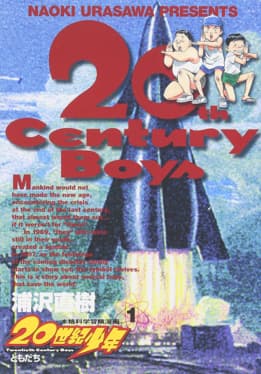
20th Century Boys Review
1999Manga
The best setup in the medium, attached to an answer that could never have carried it.
| Category | Critic | Users |
|---|---|---|
| Story | Great | |
| Art | Exceptional | |
| Characters | Exceptional | |
| World-building | Great | |
| Overall | Great |
For roughly fifteen volumes this is as gripping as serialised fiction gets. Urasawa cuts between a 1969 childhood, a 1997 present and a later ruined future, and every jump recontextualises something a reader thought was settled, so a detail as small as which boy was allowed into a grass hut becomes the hinge of a global catastrophe. The nostalgia is doing real work rather than decorating, because the point is that a group of adults cannot remember their own childhood accurately enough to identify the person destroying the world.
Kenji is a wonderfully unheroic lead, a convenience store manager with a niece and a guitar, and the supporting cast is the deepest Urasawa has drawn. Then the reveal arrives. The identity of Friend has to explain a mythology built for twenty volumes, and no name could, so the book produces one anyway, follows it with a second reveal to patch the first, and closes on a coda so unsatisfying that a two volume sequel exists to soften it. The award record is the strongest of anything here. The failure is at the exact point that matters most.
20th Century Boys at a glance
Official site- Author
- Naoki Urasawa
- Serialization start
- 1999
- Volumes
- 22
- Status
- Complete
What’s your grade?
Grade by category
No account needed. Sign in so your grades follow you and count once. · how vote integrity works
Comments
Plain text, 500 characters. Be sharp, not cruel.
No comments yet. Have the first take.